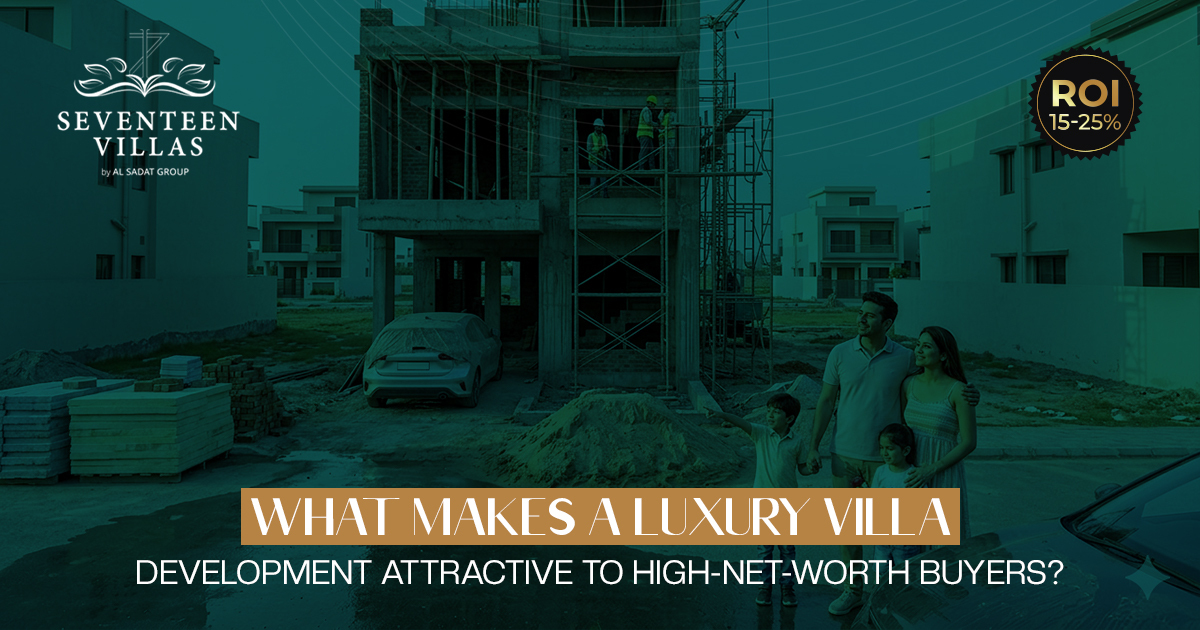
High-net-worth buyers judge a luxury villa development on connectivity, privacy and security, intelligent design and planning, build quality, and whether value holds up over time — not on price or finishes alone. This guide breaks down each factor, using Seventeen Villas in Islamabad as a working example of the approach.
Introduction
Price alone has never been the differentiator at this level — the buyers who can afford anywhere scrutinize a development hardest before committing. What separates a development that earns their interest from one that doesn’t usually comes down to a short list of fundamentals, examined below.
Location and Accessibility: The Foundation of Every Decision
For a high-net-worth buyer, location isn’t just a convenience — it’s a daily productivity question. Executives, overseas investors and frequent travellers weigh proximity to an airport, main road networks, and business districts as heavily as they weigh the villa itself. A development that sits close to Ring Road and Girja Road, near the toll plaza and within a short drive of the airport, removes friction from a schedule that doesn’t have room for long commutes. Seventeen Villas is positioned 1 min from Ring Road/Girja Road, 4 min from the airport, 3 min from the toll plaza, and 5 min from the Daewoo Terminal — the kind of connectivity that shapes daily usability, though it does not by itself guarantee future appreciation.
Architectural Quality and Thoughtful Design
At the luxury tier, design discipline matters more than square footage. A villa earns the label through an intelligent floor plan that separates private family space from guest areas, strong natural light and cross-ventilation across most rooms, and proportions that feel comfortable rather than merely large. This distinction, what separates a genuinely luxurious villa from one that only looks expensive, is worth understanding before comparing floor plans, since a striking facade says little about how a home actually functions day to day.
Privacy, Exclusivity and Security
Privacy and security sit near the top of every high-net-worth buyer’s checklist, often above amenities. A private entrance, dedicated parking, and a controlled community environment reduce the everyday friction that comes with shared or exposed access. Gated entry, low-density layouts, and clear separation between public and private zones all contribute to a sense of exclusivity that can’t be manufactured after the fact — it has to be designed into the master plan from the start.
Amenities, Lifestyle and Smart-Home Technology
Lifestyle amenities matter, but high-net-worth buyers tend to evaluate them for genuine usability rather than novelty. Covered parking, private balconies or terraces, and layouts built around actual family living carry more weight than a long feature list. Smart-home technology, where it’s genuinely integrated rather than bolted on, adds convenience and security, but buyers at this level are quick to distinguish real functionality from marketing language — a system worth having is one that’s actually used, not just listed in a brochure.
Landscaping, Community Planning and Long-Term Livability
A villa doesn’t exist in isolation, and buyers increasingly evaluate the community around it as closely as the home itself. Thoughtful landscaping, walkable layouts, and proximity to complementary residential, commercial and service activity all shape how a development feels to live in over years, not just at move-in. This is part of why mixed-use community planning appeals to long-term buyers and investors alike: a setting where daily needs sit closer to home tends to hold its relevance as the surrounding area matures, though how much depends on execution and market conditions rather than the plan alone.
Construction Quality, Maintenance and Developer Reputation
Finishes photograph well; build quality is what buyers live with. High-net-worth purchasers tend to verify construction standards in person rather than through renderings, and they weigh a developer’s track record heavily, since long-term maintenance and community upkeep depend on the same organisation staying accountable after handover. A development backed by a credible, established developer with documented projects behind it carries a different level of confidence than one built entirely on projected renderings.
Investment Potential and Long-Term Value
Luxury real estate is rarely bought on lifestyle alone; most high-net-worth buyers also expect the asset to hold or grow in value. Location fundamentals, construction quality, and community planning all factor into that expectation, but none of it amounts to a guarantee. Property values move with market conditions, and appreciation depends on execution, demand, and the broader trajectory of the surrounding area — buyers should treat any projected return as an assumption to verify, not a promise, and should confirm current pricing and payment terms directly before committing.
What This Means for Buyers Evaluating Their Options
A development that brings location, design, privacy, construction quality, and long-term planning together, rather than excelling at only one, is the kind that tends to hold its appeal over time. Seventeen Villas, developed by Al Sadat Group, reflects this approach through its Executive, Prime and Royal villa categories, its connectivity near Ring Road and Girja Road, and villa features built around covered parking, private balconies and terraces, and practical family layouts. Buyers comparing options in Islamabad’s villa market can review current villa types and payment terms directly before deciding.
Frequently Asked Questions
What do high-net-worth buyers look for in a luxury villa development?
Connectivity and accessibility, architectural quality, privacy and security, genuinely useful amenities, and a developer’s track record for construction quality and long-term value tend to matter more than size or price alone.
Does smart-home technology add real value to a luxury villa?
It can, when it’s functionally integrated rather than used as a marketing feature. Buyers generally value systems that improve daily convenience and security over long feature lists.
How important is location compared to design in luxury real estate?
Both matter, and neither substitutes for the other. A well-designed villa in a poorly connected area loses practical value, while a well-located villa with weak design still falls short of genuine luxury.
Does a luxury villa development guarantee strong investment returns?
No. Location, planning and construction quality can support long-term value, but property appreciation depends on market conditions and execution, and should never be treated as guaranteed.
What role does community planning play in luxury villa living?
Landscaping, walkability, and proximity to complementary residential and commercial activity shape how livable and relevant a development remains as the surrounding area develops over time.