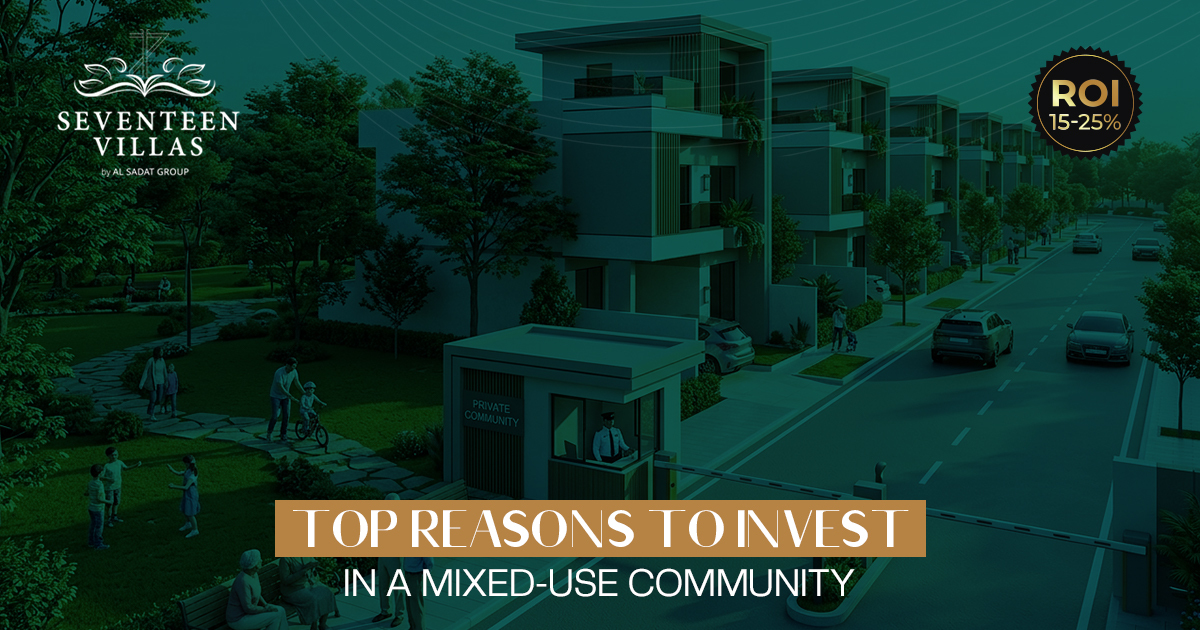
Property buyers today rarely think about a home in isolation. Most also ask what surrounds it — a market, a school, a main road, a place to work. This shift has brought attention to mixed-use communities, developments that bring different but compatible uses together in one planned environment. For buyers weighing a villa investment in Pakistan or property investment near Islamabad, understanding what a mixed-use community offers — and what it doesn’t automatically guarantee — is a useful starting point.
What Is a Mixed-Use Community?
A mixed-use community combines more than one type of land use — typically residential, commercial, retail, hospitality or community facilities — within a single, connected area. Instead of separating homes from everyday amenities, the goal is to bring them closer together, so residents can live, shop, work or socialise without depending entirely on distant parts of the city. This model has grown popular in mixed-use real estate investment in Pakistan because it reflects how people actually want to live: with convenience built into daily routine rather than added to it.
Top Reasons to Invest in a Mixed-Use Community
- Convenience creates demand. When everyday needs sit closer to home, residents save time and effort, which can make a community more attractive to both renters and buyers.
- Multiple economic activities. Residential, commercial and service activity operating side by side can create a more active, self-sustaining environment rather than one that depends on a single use.
- Potential for stronger local footfall. Easier accessibility and nearby commercial activity can support higher footfall, though actual footfall always depends on execution, occupancy and market demand.
- Lifestyle and investment can work together. Buyers increasingly want a property that is livable today and holds relevance tomorrow, rather than choosing between the two.
- Better use of location. Proximity to major roads, employment hubs, airports and city centres can meaningfully influence how attractive a property remains over time.
- Diversification. A community offering different property-use opportunities gives investors more than one demand driver to rely on, rather than a single narrow segment.
- Long-term community value. When infrastructure, services and accessibility develop together, a planned community can become more usable and relevant as the surrounding area matures.
- Exit and demand considerations. Resale and rental interest depend on market conditions, development progress and pricing — factors worth reviewing before, not after, a purchase.
Why Location Matters in Mixed-Use Real Estate
Connectivity often determines whether a community’s benefits are realised in practice. Proximity to motorways, airports and urban centres directly affects daily convenience and, over time, buyer and tenant interest. This is one reason investment opportunities in Rawalpindi and the wider Islamabad corridor have drawn growing attention — infrastructure such as ring roads and interchanges tends to reshape which locations become practical rather than peripheral.
Seventeen Villas, developed by Al Sadat Group, sits within this conversation because of its access rather than any specific commercial component. The project is positioned near Ring Road and Girja Road, close to Thalian Interchange, with routes toward both Islamabad and Rawalpindi and reasonable proximity to Islamabad International Airport. For a modern villa community in Rawalpindi, this connectivity is a practical consideration rather than a promotional one — it affects commuting, access to nearby sectors, and how the area develops over time.
Why Seventeen Villas Deserves a Closer Look
It’s worth being precise here: Seventeen Villas is a residential villa community, not a commercial or retail development. Its own offering is villa-focused, spread across Executive, Prime and Royal categories in 2, 3 and 4-bedroom layouts. What connects it to the mixed-use conversation is its setting — a growth corridor near established and emerging sectors, where residential, educational and commercial activity are developing in proximity to one another.
Beyond location, Seventeen Villas’ villa options are built with everyday practicality in mind — covered parking, private balconies or terraces, and modern layouts for family living. For buyers exploring Seventeen Villas investment, it’s worth reviewing the Seventeen Villas payment plan directly, since instalment structures and financing terms can change and should be confirmed before commitment.
What Should Investors Check Before Buying?
- Legal status and map approval of the project
- Developer track record and credibility
- Actual development progress on the ground
- Payment terms, instalment structure and total cost
- Personal affordability, not just advertised pricing
- Documentation and ownership transfer process
- Realistic rental and resale demand in the area
Is a Mixed-Use Community Right for Every Investor?
Not necessarily. Suitability depends on financial capacity, investment horizon, risk tolerance and personal goals. A buyer looking for a primary residence may prioritise livability and accessibility, while an investor may weigh location fundamentals and long-term area development more heavily. Neither approach guarantees a specific outcome — property values move with market conditions, and every purchase deserves independent evaluation rather than assumptions about appreciation.