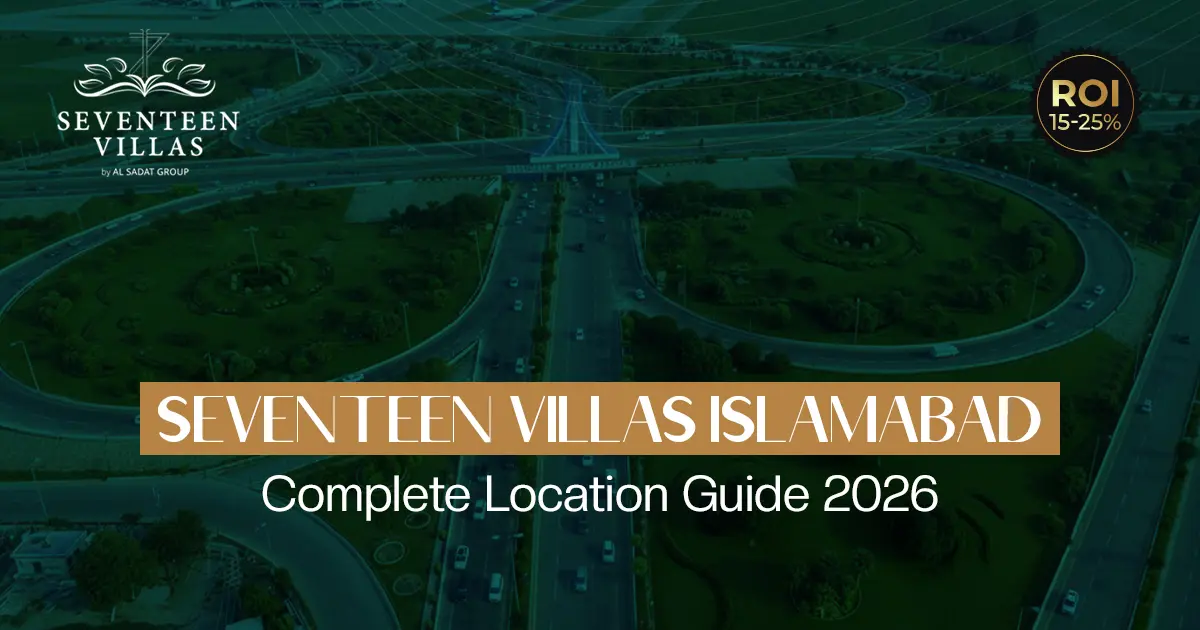
There’s an old adage in real estate: the three things that matter most are location, location, and location. It sounds cliché until you look at a project like Seventeen Villas Islamabad and realize that the adage still holds up.
Islamabad has seen many housing projects launched in the last decade. Most of them compete on facilities, payment plans, and marketing budgets. A smaller number competes on something that’s harder to do: where they actually sit on the map.
Seventeen Villas is located near the Thalian Interchange — a junction that connects Islamabad’s Ring Road to the M-2 Motorway and puts the project within easy reach of the new Islamabad International Airport, central Rawalpindi, and the wider CPEC corridor. Whether you are an investor, an overseas Pakistani looking for capital in a stable area, or a family who wants a home without the chaos of inner-city traffic, the location alone deserves a closer look.
This guide covers everything: exact location, connections, nearby landmarks, why the Thalian Interchange is more important than most people realize, and what the area will look like five to ten years from now.
1. Exact Location of Seventeen Villas Islamabad
Seventeen Villas Islamabad is located near the Thalian Interchange on the outskirts of Islamabad, in a zone located at the confluence of several major arteries.
Thalian itself is a node on the western edge of Islamabad, where the M-2 Lahore-Islamabad Motorway, the Islamabad Ring Road, and the roads to the new airport all converge. The interchange has quietly become one of the most strategic pieces of regional road infrastructure in both cities.
The project is positioned so residents and investors can have access to open, uncrowded land with future development potential — not far enough from the city that daily life would be inconvenient.
What Does ‘Near Thalian Interchange’ Actually Mean?
This means that the project is sited where main road infrastructure already exists and further expansion is planned. Unlike many housing schemes that describe themselves as ‘close to Islamabad’ while sitting an hour away in light traffic, Seventeen Villas’ proximity to Thalian keeps it authentically connected to Islamabad and Rawalpindi.
For investors who have seen lots in the B-17, FECHS, and DHA Phase 2 Extension appreciate significantly over the years, the pattern is familiar: projects near major infrastructure corridors tend to outperform those that rely entirely on interior facilities.
2. Accessibility & Connectivity
Good connectivity isn’t just about convenience — it’s a hard financial variable. Properties that take forty minutes to reach from the city center fall short compared to those on the main artery. Here’s how Seventeen Villas stacks up.
Islamabad International Airport
New Islamabad International Airport (IATA: ISB) is the main air travel gateway in the region. The airport is located near Fateh Jang Road, almost on the same western corridor as the Thalian Interchange. This means that residents at Seventeen Villas have a short and straightforward route to the airport without going through the congested inner city.
For overseas Pakistanis — a key buyer segment for any project in Islamabad by 2026 — proximity to the airport is no small detail. This affects how often they can visit, how quickly they can get to their property, and how practical it is to manage an investment from abroad.
On Road Islamabad
The Islamabad Ring Road project is one of the most significant infrastructure developments the city has seen in years. The Ring Road is designed to reduce congestion on major arteries running through the G-series sectors and create a loop that allows traffic to move around the city rather than through it.
Seventeen Villas’ position near the Thalian Interchange means it’s close to the western side of the Ring Road — the section that connects southern and western Islamabad to the motorway network. As phases of the Ring Road progress and usage increases, this feature will only grow in importance. Projects along this corridor have historically seen land value appreciation that has outpaced projects in more central but congested locations.
Rawalpindi Access
Rawalpindi is not just a separate city — it is the commercial, military, and industrial backbone of the two-city region. The location of Seventeen Villas via Thalian makes it accessible from the main thoroughfares of Rawalpindi without requiring residents to traverse the congestion of inner Islamabad. The Rawalpindi Ring Road project, which is also under development, will further tighten this connectivity in the coming years.
CPEC Route Connection
The China-Pakistan Economic Corridor has fundamentally changed how investors view land along several of Pakistan’s corridors. The western alignment of CPEC runs through Punjab and connects with the motorway network. Thalian’s position on M-2 and close to the Ring Road means it sits alongside routes that feed into this broader economic artery.
This is not speculative: infrastructure investment along routes adjacent to CPEC has already created commercial activity, warehousing, logistics hubs, and residential demand in several districts of Punjab. Islamabad’s western corridor is part of this story.
Girja Road Connectivity
Seventeen Villas also connects conveniently to Girja Road, improving accessibility to key areas of Rawalpindi and surrounding developments. This increased connectivity improves accessibility and the long-term value of the investment.
3. Nearby Landmarks & Attractions
Islamabad International Airport
Already mentioned for connectivity, the airport also acts as an economic engine. Areas near the airport continue to attract hotels, logistics companies, service businesses, and a transient residential population. The commercial flow from the airport to the Thalian corridor is already visible and will intensify as passenger numbers increase.
Major Road Networks
The M-2 Motorway (Lahore-Islamabad), the Ring Road Islamabad western section, Girja Road and Fateh Jang Road are the main arteries surrounding the project zone. Each of these roads may be fully operational or under active development. Residents have multiple route options — which is important practically because road closures, construction, and peak-hour congestion affect daily life in ways that single-road access points don’t.
Commercial Growth Zones
Thalian and its surrounding tehsil area has attracted commercial interest as land is still available at affordable prices compared to central Islamabad. Gas stations, roadside commercial strips, and small industrial units have begun to appear. As the residential footprint grows, formal retail, schools, and clinics follow suit — this is the typical sequence of urban growth, and Thalian is in the early-to-mid stages of it.
Access to Education and Healthcare
Private schools and hospital networks in Rawalpindi are accessible from Thalian through existing roads. Several major private hospital groups and school chains have expansion plans in the western Islamabad-Rawalpindi belt. For families evaluating Seventeen Villas as a long-term home, this is crucial — a good house in a location with no decent schools or hospital within ten minutes is a harder sell to a spouse or parent.
4. Why Thalian Interchange Matters More Than Most People Realise
Thalian Interchange is not yet a household name. That, frankly, is part of the investment case.
When an interchange becomes well-known — when it appears on every investor’s shortlist, when prices have adjusted — the upside is largely captured. Thalian is at an earlier stage. The infrastructure is real and functional. Ring Road development is confirmed and ongoing. The airport was open and busy. But corridor land prices have yet to catch up to what infrastructure suggests they should be worth.
Future Development Potential
Government-led infrastructure such as ring roads and interchanges are not built in isolation. It signals where the city’s development is expected to go. Planners lay roads to growth corridors and the land they expect to see developed. Thalian’s placement at the interchange is no accident — it’s indicative of where Islamabad’s westward expansion is headed.
Traffic Connections
The interchange reduces driving time between the motorway, Ring Road, and internal sectors of Islamabad. As the city grew westward and the phases of the Ring Road came to an end, Thalian became more of a central node than a peripheral one. That’s a dynamic that buyers and investors in 2026 can still get ahead of.
Real Estate Demand Growth
Real estate demand is often a lagging indicator — people recognize value after prices have moved. The buyers that do well are the ones that identify the infrastructure story early. In Thalian’s case, the Ring Road, the airport corridor, and the CPEC-adjacent position provide reasonably clear signals of where demand is headed.
5. Future Growth Potential of the Area
Infrastructure Expansion
The Ring Road Islamabad project has multiple phases. As each phase ends, the effective catchment area of Thalian’s interchange grows. Currently light-traffic roads will carry heavier commercial and residential loads. Utilities – gas, electricity, sewer – follow the roads. The infrastructure backbone that makes urban life accessible is being laid.
Beyond roads, both the Capital Development Authority (CDA) and the relevant provincial authorities have taken an interest in developing the western corridor. New sectors, commercial zones, and public infrastructure (schools, hospitals, parks) are all part of Islamabad’s long-term planning.
Trends in Investment Growth
Islamabad’s property market in 2026 is being shaped by several clear forces: Pakistan’s overseas remittances flowing into real estate, tighter regulation of grey-market property schemes pushing buyers towards registered projects, and the shortage of well-appointed lots in residential areas established sectors. Projects like Seventeen Villas, located near confirmed infrastructure, sit in the part of the market that benefits from all three trends.
Historically, plots near interchanges connecting the Ring Road in Islamabad and Rawalpindi have appreciated by 30 to 50 per cent within five years of the road’s operation. The Thalian section of the Ring Road is booming, and that trajectory has reason to continue.
Impact on Urban Development
Cities expand outward from their centers along infrastructure corridors — motorways, ring roads, and arterial roads. Islamabad’s westward expansion along the M-2 and Ring Road alignment is in full swing. Seventeen Villas sit along this expansion corridor. Urban planners call this corridor development: development that occurs linearly along major thoroughfares as cities mature.
For buyers in 2026, the question isn’t whether Thalian will thrive — it clearly will. The question is whether you’re participating in that growth now, or reading about it in a 2030 market report.
Frequently Asked Questions
Optimized for People Also Ask — common questions answered directly.
Q: Where is Seventeen Villas Islamabad located?
A: Seventeen Villas Islamabad is located near Thalian Interchange, on the western fringe of Islamabad. The project sits at the junction of the M-2 Lahore-Islamabad Motorway, the Islamabad Ring Road, and the route toward the new Islamabad International Airport — making it one of the most accessibly positioned housing developments in the twin-cities area.
Q: How far is Seventeen Villas from Islamabad Airport?
A: Seventeen Villas is close to Islamabad International Airport. Because both the project and the airport sit in Islamabad’s western corridor, the drive avoids the congested interior of the city. The exact travel time varies with road conditions and traffic, but the corridor alignment makes the airport significantly more accessible than it would be from central Islamabad sectors.
Q: Is Seventeen Villas near Ring Road Islamabad?
A: Yes. Seventeen Villas is positioned near the Ring Road Islamabad’s western section, close to Thalian Interchange. The Ring Road is a major infrastructure project designed to ease cross-city traffic and improve access to Islamabad’s outer zones. Projects near the Ring Road corridor have historically seen strong capital appreciation as road phases complete and usage increases.
Q: Why is Thalian Interchange important for real estate?
A: Thalian Interchange sits at the convergence of the M-2 Motorway, the Ring Road Islamabad, and the airport approach routes. This makes it one of the most strategically connected points in the twin-cities region. Interchange locations drive commercial activity, attract infrastructure investment, and create residential demand — all of which support property value appreciation over time.
Q: Is the location of Seventeen Villas good for investment in 2026?
A: The location has several strong investment indicators: confirmed infrastructure nearby (Ring Road, M-2, airport), CPEC-adjacent corridor positioning, early-stage land pricing relative to what the infrastructure suggests, and growing residential demand in Islamabad’s western belt. Investors who tracked similar interchange-adjacent projects in Islamabad and Rawalpindi over the past decade saw consistent value growth. The same structural forces are present in the Thalian corridor.
Q: Is Seventeen Villas accessible from Rawalpindi?
A: Yes. Thalian’s position connects the project to Rawalpindi via existing road networks without requiring passage through Islamabad’s central sectors. As the Rawalpindi Ring Road project develops further and road links in the western belt improve, this accessibility will increase. Rawalpindi’s commercial and industrial base makes this connectivity practically important for both residents and investors.
Q: What future developments are planned near Seventeen Villas?
A: The broader Thalian-Islamabad western corridor is expected to see continued Ring Road phase completions, commercial zone development adjacent to the airport, expansion of CDA-planned sectors in the western belt, and infrastructure upgrades tied to CPEC-aligned development. While specific project timelines depend on government planning cycles, the direction of development in this corridor is consistent and supported by confirmed infrastructure commitments.
Final Word
Seventeen Villas Islamabad is not the loudest project in the market in 2026. It does not need to be. Its location near Thalian Interchange — with direct access to the Ring Road, the airport, the M-2 Motorway, and the CPEC-aligned western corridor — does the talking.
For overseas Pakistanis looking for a place to invest with confidence, for families wanting a home outside the congestion without sacrificing connectivity, and for investors who have learned to read infrastructure signals before the market does: Thalian is worth understanding now.
The infrastructure is real. The growth trajectory is visible. The question is timing.