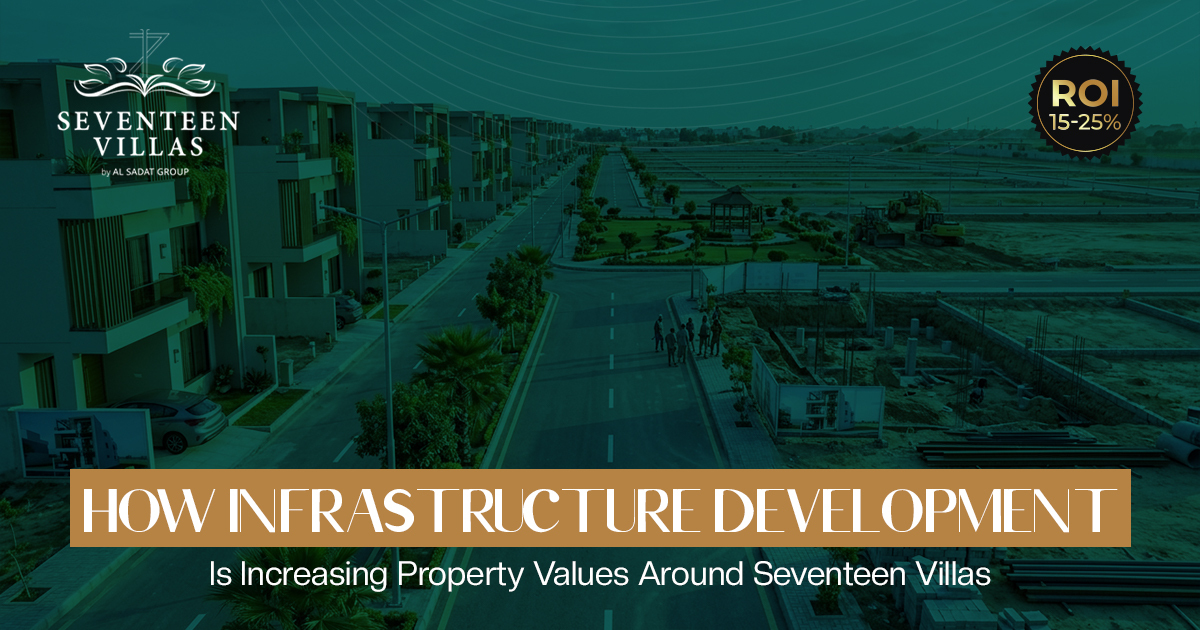
Infrastructure development — airports, motorways, and interchanges — tends to increase surrounding property values by improving accessibility, reducing commute times, and attracting commercial activity. Seventeen Villas Islamabad sits immediately after the Thalian Interchange on the Islamabad Airport Corridor, giving it direct access to the M-2 Motorway, Ring Road, and Islamabad International Airport. Infrastructure proximity supports long-term demand, but it does not guarantee price appreciation.
Experienced property investors rarely start by looking at a house. They start by looking at a map — tracing where the next road, interchange, or airport expansion is headed, because infrastructure has a long, well-documented history of reshaping real estate demand years before it reshapes prices. Roads bring commuters. Airports bring commerce. Interchanges bring both, faster than either alone. This is not a Pakistani phenomenon; it is a pattern seen from the M25 corridor around London to the ring roads circling Istanbul.
Islamabad’s own version of this story is unfolding along the Airport Corridor, where the Thalian Interchange, the M-2 Motorway, and the Rawalpindi Ring Road have converged within a short stretch of road. Understanding why this matters — and how it applies to a specific community like Seventeen Villas — requires looking at infrastructure the way analysts do: as a leading indicator, not a promise.
Why Infrastructure Matters in Real Estate
Infrastructure changes the practical value of land well before it changes its price tag. A few mechanisms explain why:
- Improved accessibility — new roads and interchanges shorten the distance between a location and the places people need to reach daily, from workplaces to airports.
- Reduced travel times — commute time is one of the most consistent factors buyers weigh, often more heavily than plot size or finish quality.
- Economic activity — better-connected areas attract retail, logistics, and service businesses, which in turn create local employment.
- Business growth — commercial expansion near transport hubs tends to draw supporting residential demand from employees and business owners alike.
- Population movement — as commute times shrink, previously peripheral locations become realistic options for people who work in the city center.
- Increased housing demand — the cumulative effect of the above is a steadily growing buyer pool for well-located residential communities.
Major Infrastructure Projects Supporting the Airport Corridor
Several large infrastructure projects have converged along the same stretch of road north of Islamabad, which is unusual given typical development timelines in Pakistan.
- Islamabad International Airport — a fully operational aviation hub that anchors both commercial and residential demand along the corridor.
- Thalian Interchange — connects the corridor directly to the M-2 Motorway, placing Lahore under three hours away without routing through central Islamabad or Rawalpindi.
- M-2 Motorway — provides fast intercity travel and national highway access from a corridor that was, until recently, largely farmland.
- Ring Road connectivity — the Rawalpindi Ring Road allows residents to bypass congested city routes when traveling between the twin cities.
- Airport Corridor development — new housing schemes and commercial activity have followed the road network, gradually turning a peripheral stretch into a closely watched investment corridor.
These projects improve connectivity and can influence surrounding residential markets over time, but they do not guarantee future price movement. Location quality is one variable among several — developer credibility, approval status, and construction progress matter just as much.
Why the Islamabad Airport Corridor Is Attracting Major Property Investment covers this corridor’s development in more depth for readers who want the full picture.
How Seventeen Villas Benefits From Its Strategic Location
Seventeen Villas Islamabad sits immediately after the Thalian Interchange, making it one of the first residential communities reached after leaving the interchange.
- Proximity to major road networks — roughly one minute from Ring Road and Girja Road.
- Easy airport access — approximately four minutes from Islamabad International Airport.
- Toll plaza proximity — about three minutes from the Islamabad Toll Plaza at Thalian Interchange.
- Connectivity to Rawalpindi — around five minutes from the Daewoo Express Terminal.
- Lifestyle advantages — a low-density, villa-format layout that stands apart from the higher-density housing typical of many peripheral schemes.
- Appeal to long-term investors — a residential asset positioned inside an active infrastructure corridor, with outcomes still dependent on individual circumstances and broader market conditions.
This positioning places the community within a few minutes of the corridor’s core advantages — airport access, motorway connectivity, and Ring Road efficiency — without depending on any single one of them.
Explore how Seventeen Villas combines connectivity, lifestyle, and long-term potential in one location. Contact Seventeen Villas to schedule a consultation or site visit.
Infrastructure Factor vs Property Impact
| Infrastructure Factor | Property Impact |
| Islamabad International Airport | Anchors commercial and residential demand with established travel activity |
| Thalian Interchange & M-2 Motorway | Direct national connectivity, including Lahore access in under three hours |
| Rawalpindi Ring Road | Bypass access that reduces commute time to both twin cities |
| Commercial expansion nearby | New business activity that follows improved road access |
| Limited villa-format supply | Managed, low-density communities remain relatively scarce along the corridor |
What Smart Investors Look for Before Buying Property
Infrastructure proximity is an important factor, but experienced buyers weigh it alongside several others before making a decision:
- Infrastructure — proximity to functioning roads, airports, and interchanges rather than projects still in planning.
- Accessibility — realistic commute times to work, schools, and essential services, not just distance on a map.
- Community planning — density, green space, and how a development is laid out for daily living rather than maximum unit count.
- Developer credibility — a track record of delivering projects on schedule and as approved.
- Future growth potential — evidence of continued infrastructure investment rather than a single completed project.
- Lifestyle value — whether the property genuinely suits how a family or individual intends to live, not only its resale potential.
- Long-term demand — signs of a diversified buyer pool, including local residents, overseas Pakistanis, and long-term investors.
Planning your first property purchase? First-Time Villa Buyer’s Guide: Everything You Should Know Before Investing walks through these factors in more detail before you make a decision.
| Expert Insight
Infrastructure-led corridors tend to reward early, well-researched positioning more than late entry after a project is already built out. The safest approach is to evaluate a specific community’s access, planning, and developer track record independently — rather than relying on the presence of nearby infrastructure alone as an investment thesis. |
Conclusion: Infrastructure as a Long-Term Indicator
Infrastructure remains one of the most consistent long-term indicators of real estate demand — not because it guarantees appreciation, but because it reliably reshapes accessibility, economic activity, and population movement over time. The Islamabad Airport Corridor has reached a stage where its core infrastructure is largely built rather than promised, which sets it apart from many peripheral development zones.
Seventeen Villas Islamabad occupies one of the corridor’s most direct access points, combining villa-format living with proximity to the airport, motorway, and Ring Road. As with any property decision, the location’s advantages are best evaluated alongside developer credibility, planning quality, and individual circumstances.
Contact us today to schedule a consultation or site visit.
Frequently Asked Questions
Does infrastructure development actually increase property values?
Infrastructure development tends to increase the baseline demand for property by improving accessibility and attracting economic activity, which can support long-term value. It does not guarantee appreciation, and outcomes vary by project and market conditions.
Why is the Islamabad Airport Corridor attracting investment?
The corridor combines a functioning international airport, completed motorway and Ring Road access, and growing commercial activity — a combination of built, rather than planned, infrastructure that reduces uncertainty for buyers.
How close is Seventeen Villas to Islamabad International Airport?
Seventeen Villas Islamabad is approximately four minutes from Islamabad International Airport and roughly three minutes from the Islamabad Toll Plaza at Thalian Interchange.
What is the Thalian Interchange and why does it matter?
The Thalian Interchange connects the Islamabad Airport Corridor directly to the M-2 Motorway, providing access to Lahore and the national highway network without routing through central Islamabad or Rawalpindi.
Is proximity to infrastructure a guarantee of property appreciation?
No. Infrastructure proximity is one factor among several, including developer credibility, community planning, and market conditions. It supports demand but does not guarantee price growth.
What should first-time buyers evaluate before purchasing near an infrastructure corridor?
Buyers should assess infrastructure maturity, accessibility, developer track record, community planning, and realistic long-term demand rather than relying on location alone.
How does Seventeen Villas compare to other developments along the corridor?
Seventeen Villas is positioned as a low-density, villa-format community immediately after the Thalian Interchange, which distinguishes it from higher-density housing schemes elsewhere along the corridor.