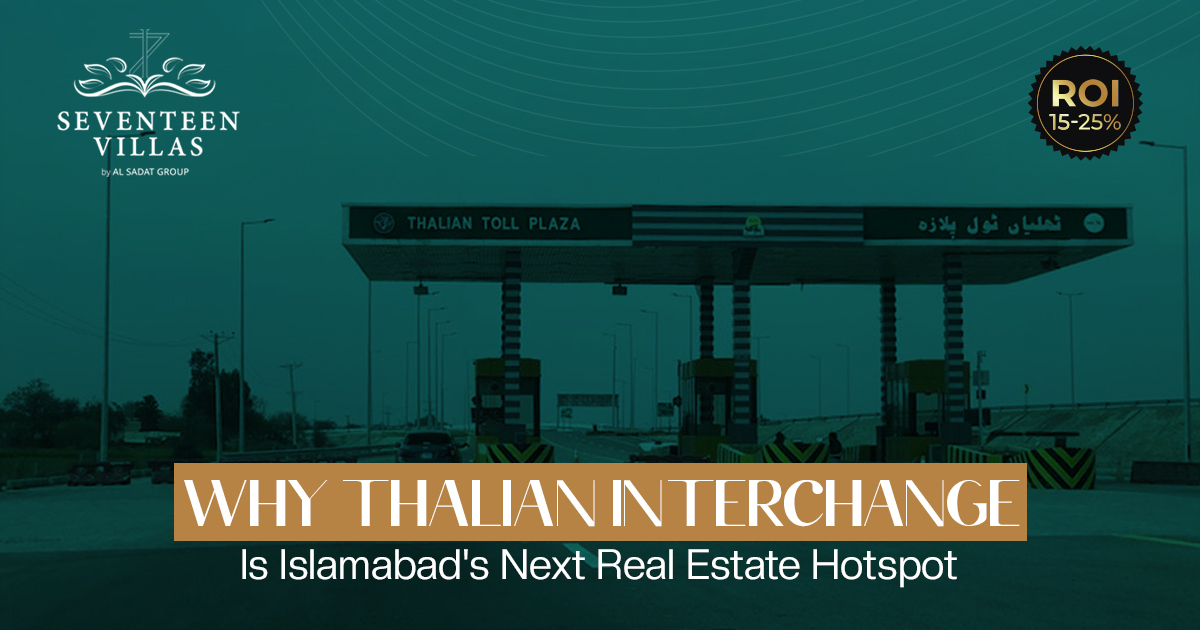
Let’s be direct about what makes a location worth serious consideration. It comes down to three things: access, trajectory, and price relative to both.
Thalian Interchange scores well on all three.
Access. The interchange sits on the M-2 Motorway — the Islamabad-Lahore corridor that has shaped economic geography across this region for two decades. From Thalian, the new Islamabad International Airport is a 10 to 15-minute drive. Lahore is under two hours. The Srinagar Highway connects you to Islamabad’s core without fighting the congestion that chokes the older arterial routes. Rawalpindi is accessible without the city-centre traffic that adds 45 minutes to journeys that should take 20.
This is not theoretical connectivity. It is operational, available right now, every day. That distinction matters more than it gets credit for.
Trajectory. Development activity around Thalian has visibly accelerated. Housing schemes are being launched. Agricultural land is converting to residential. Commercial plots are attracting buyers who aren’t usually early movers. These are market signals that precede broader demand — developers and informed investors who make their money by positioning before the end-user market arrives.
Price. Land values around Thalian still reflect the area’s historical status as peripheral to Islamabad proper. They have not yet caught up to what the location’s connectivity actually justifies. That gap — between what prices are and what the fundamentals suggest they should be — is precisely where property investment opportunity concentrates.
What happens when genuine accessibility meets prices that haven’t adjusted for it yet? Historically, in Islamabad and in every comparable market, the answer is appreciation. Sometimes fast. Sometimes steady. But almost always sustained when the underlying infrastructure is real.
Infrastructure Is the First Signal — Here’s How to Read It
There is a reason experienced property investors pay attention to government infrastructure budgets before they read any market report.
Roads, interchanges, water networks, and utility lines are not built where governments hope development might happen. They are built where population projections and economic planning indicate development is going to happen. Infrastructure follows demographic reality and precedes market recognition. By the time the market has fully recognized a location, the infrastructure signal has already been visible for years.
Islamabad’s own history makes this concrete. Before E-11 became one of the capital’s most desirable addresses, road access was developed. Before DHA commanded the premiums it does today, infrastructure came first. Bahria Town’s early phases attracted buyers partly because the developer understood that accessibility was the actual product — the houses were secondary to what the roads made possible.
“Roads do more than connect destinations. They connect possibilities — and possibility is what property value is ultimately made of.”
Thalian Interchange is, by definition, an infrastructure node. The interchange itself exists. The motorway it connects to exists. The airport nearby is operating and handling international traffic. None of this is promised future infrastructure. It is present, functional, and already changing the practical geography of eastern Islamabad in ways that property prices haven’t fully caught up to yet.
The development activity gathering around that infrastructure is the second signal. The third — rising prices as demand catches up — tends to arrive faster than most buyers expect and slower than most sellers would like.
Investors who understand this sequence rarely look at a new interchange without asking: what will this location be worth to someone five years from now?
Why Families Are Moving Beyond the Traditional Sectors
Ask anyone who bought in Bahria Phase 1 in its early years, or in DHA’s first sectors when they were still new, why they made that decision. You’ll hear the same answer in different versions: they wanted quality housing at a price they could actually pay, with enough space to raise children properly, in a community that felt planned rather than improvised.
That hasn’t changed. What’s changed is that those early buyers were right — which means prices now reflect their being right — and new buyers who want what they wanted can no longer find it there at comparable prices.
F-6 and F-7 are genuinely excellent addresses. For a family earning a professional income and saving carefully, they also often require either inherited wealth or 15 years of capital accumulation to enter. The established Bahria phases have appreciated to the point where entry prices require the kind of liquidity that first-generation wealth builders rarely have sitting idle.
This doesn’t mean those sectors aren’t good assets. They are. But they have already done most of their appreciating. The family buying in F-7 today is buying stability and prestige, not early-stage value.
The family looking for what Bahria Phase 1 was in 2005 — planned community, modern infrastructure, room to breathe, at a price that rewards patience rather than punishing it — is now looking at corridors like Thalian. Not as a downgrade, but as the same decision made with the same logic, just at the location where that logic currently applies.
Are buyers simply choosing a plot — or are they choosing the kind of life they want their family to grow into?
Almost always, it’s the second thing. And Thalian offers that answer at a price point the capital’s established sectors stopped offering years ago.
If you’re a family looking at your next property decision, Seventeen Villas has residential inventory near Thalian Interchange available now — including flexible payment plans designed for buyers who don’t want to overextend. Reach out before the pre-launch pricing phase closes.
The Overseas Pakistani Perspective — And Why It Points Here
Spend time with overseas Pakistanis in Manchester, Dubai, Toronto, or Riyadh when the conversation turns to investment back home. You’ll notice something consistent: the emotional weight of the decision doesn’t fit any standard investment framework.
It isn’t purely about yield. It isn’t purely about capital appreciation. It is about something harder to quantify — the need to maintain a stake in a country that remains home in ways geography can’t fully erase. A property in Islamabad means there’s somewhere to return to. It means children have a connection to Pakistan that isn’t just stories. It means savings built abroad aren’t entirely exposed to the currency and institutional risks of the country where they were earned.
“Distance changes geography, but it doesn’t change the desire to build something real back home.”
What has changed among overseas Pakistani investors over the past decade is the sophistication of their questions. They’ve been burned by developers who promised and didn’t deliver. They’ve navigated the confusion of schemes with impressive marketing and insufficient documentation. They’ve learned to ask harder, more specific questions: Is the NOC genuine and current? Has this developer actually completed a project before? Can I verify the title chain independently? What is the actual driving time to the airport?
Thalian Interchange answers these questions well, when the project is the right one. The location is independently verifiable — anyone can drive from the airport and time the journey themselves. The infrastructure is physical and existing, not contingent on future government action. The connectivity is a matter of measurement, not a marketing claim.
For overseas Pakistanis placing capital that carries both financial and personal significance, Thalian offers something that is genuinely harder to find than it sounds: a location where the fundamentals hold up under scrutiny.
Seventeen Villas has worked specifically with overseas Pakistani buyers. We understand the documentation requirements, the payment structures that work across borders, and the communication those buyers need when they can’t be present in person. If you’re based abroad and evaluating Islamabad real estate, contact us to arrange a detailed remote briefing — we can handle everything from documentation review to virtual site tours.
Investment Value Without the Hype
Pakistan’s real estate market has a hype problem. Too many schemes have been sold on guaranteed return promises, unrealistic appreciation projections, and manufactured urgency designed to prevent buyers from thinking carefully before they commit.
The result is a market where sophisticated investors have learned to be suspicious of exactly the claims that are supposed to build their confidence. And where genuine opportunity sometimes gets undervalued because it arrives without a brass band.
So here is a straightforward account of what Thalian Interchange offers — and what nobody can honestly offer you.
What it offers: a location with operational infrastructure, genuine connectivity to Islamabad’s most significant transport nodes, prices that have not yet adjusted to reflect those fundamentals, and a trajectory of development activity that historically precedes demand-driven appreciation in comparable Islamabad corridors.
What no one can offer: a guarantee. Markets move in ways nobody predicts perfectly. Pakistan’s macroeconomic environment introduces variables that complicate any specific return forecast. Timing matters and is never perfectly controllable.
“Real estate rewards patience more consistently than it rewards prediction.”
The investment case for Thalian is not built on a return projection. It’s built on the combination of location fundamentals, infrastructure reality, and price relative to both. That combination — in Islamabad’s previous expansion corridors — has consistently produced strong outcomes for buyers who held through the full appreciation cycle.
The question worth sitting with: is short-term market noise more important than long-term fundamentals? For buyers thinking seriously about five to ten year wealth preservation in a city with Pakistan’s structural housing demand, the fundamentals here are among the more compelling currently available in Islamabad. That’s a measured statement. It is also an honest one.
What to Verify Before You Commit — Anywhere, Including Here
The most useful thing a credible real estate brand can do for buyers is explain precisely how to evaluate any property decision, including one involving that brand. If the project is genuinely sound, the scrutiny will confirm it. If it isn’t, buyers deserve to know before they sign.
Here is what to verify before committing capital to any emerging area:
Developer completion track record. Not launches — completions. Has this company actually handed over possession on a previous project? Are buyers from those projects satisfied enough to recommend the developer? Ask. Visit if you can.
Regulatory documentation. Current NOC from the relevant authority — RDA, CDA, or whichever body has jurisdiction. The title chain should be clean and verifiable independently. These are the legal foundation of your investment, not bureaucratic formalities.
Physical site visit. Go there yourself. Drive the route from the airport. Drive to the commercial areas you’d use in daily life. The distance on paper and the experience of the actual commute are sometimes significantly different.
Current versus promised infrastructure. Infrastructure that exists and is operational today matters far more than infrastructure that is planned for some future date. What can you access right now, not contingent on anything?
Who is actually buying. A location that attracts only speculative investors is more fragile than one where families are purchasing to live. End-user demand is the foundation of durable, sustained appreciation.
Payment structure. For buyers managing the budget carefully, the installment schedule matters as much as the headline price. What is the payment timeline? What flexibility exists if circumstances change?
None of this is complicated. It is simply the discipline that separates property decisions people look back on with satisfaction from ones they spend years regretting.
At Seventeen Villas, we encourage every prospective buyer to run this checklist on our project. We will provide documentation proactively. We will facilitate site visits and independent legal review. We will answer questions we would personally find uncomfortable as readily as ones we would love to hear. That is what we believe responsible selling actually looks like. Contact us and ask us the hard questions.
Where Seventeen Villas Fits Into the Thalian Story
Seventeen Villas did not arrive at Thalian Interchange because it was the trending location. It arrived because the team did the analysis — looked at the infrastructure reality, mapped the connectivity data, compared current prices to what comparable corridors in Islamabad’s expansion history looked like at the equivalent stage — and concluded that this is where serious residential development should be positioned right now.
That is a different starting point than chasing whatever is currently fashionable. It produces a different kind of project.
The philosophy behind Seventeen Villas is direct: a development succeeds long-term when it is built for the person who will live there in fifteen years, not just the one who signs the agreement today. That means construction quality that holds up under a decade of use. Community design that actually functions as a community rather than a collection of adjacent properties. Documentation that would survive scrutiny from the most skeptical buyer’s lawyer.
“Confidence grows where transparency exists — and transparency is the one thing we do not negotiate on.”
Seventeen Villas is not the loudest brand in Islamabad’s property market. That is a deliberate position. Brands that compete on the volume of their claims tend to underperform on the substance of their delivery. We would rather be the brand that buyers recommend to people they care about — because the experience matched what was promised, and then some.
If you are evaluating a property investment in Islamabad — as a local investor, a family buyer, or an overseas Pakistani — speak with the Seventeen Villas team. We will show you the Thalian project in detail, walk you through the documentation, facilitate site visits, and answer every due diligence question you have. We will let the location and the project make their own case. Contact us today to arrange a consultation or book a site visit.
The Bigger Question About Where Islamabad Goes Next
Sixty-odd years after it was drawn on paper, Islamabad looks almost nothing like the original blueprint. It has pushed outward in every direction, absorbed neighboring settlements, attracted population from across Pakistan, and developed a real estate market with genuine depth and complexity.
The challenges are real. Affordability in established sectors is a genuine constraint for large parts of the buying population. Regulatory consistency has improved but remains uneven. Not every scheme that launches delivers.
But the structural forces pushing Islamabad’s growth are not slowing. Pakistan’s population is growing. Islamabad’s economic role is expanding. The new airport has made the capital more internationally connected than at any previous point in its history. And the infrastructure investment flowing into corridors like the M-2 reflects planning decisions made with a long horizon in mind.
Which locations will define what Islamabad looks like in 2035?
Not any single development. Cities don’t get shaped by one project. They get defined by the cumulative weight of thousands of individual buying decisions, years of infrastructure investment, and dozens of development projects all gradually pointing in the same direction.
Around Thalian Interchange, those things are already pointing in the same direction.
The infrastructure is operational. The connectivity is real and independently verifiable. The prices still reflect what the area was, not what it is becoming. And the buyers paying attention to that gap — local investors who understand Islamabad’s expansion history, returning diaspora, families who have done the arithmetic on established sector pricing — are beginning to move.
That is usually when the most interesting decisions get made. Before the crowd confirms what the early movers already knew.
The question is whether you want to be among the early movers, or among the people who’ll look back and remember what Thalian was priced at in 2024 and 2025.
Frequently Asked Questions
What makes Thalian Interchange attractive for property investors?
Three things that rarely combine: operational infrastructure, genuine connectivity to major city nodes (Islamabad Airport is 10-15 minutes, Lahore under two hours via M-2, Rawalpindi easily accessible), and pricing that hasn’t yet caught up to those fundamentals. When location quality runs ahead of market price recognition, that gap is where investment value lives. Thalian is at that stage now, and the gap is closing as development activity increases.
Is Thalian Interchange a good place to buy property in Islamabad?
For buyers with a five to ten year horizon, the underlying case is solid. It suits investors looking for pre-appreciation value in a location with real infrastructure, families seeking modern planned communities at prices below the capital’s saturated sectors, and overseas Pakistanis wanting Islamabad property with verifiable present-tense connectivity. It is not a short-term flip strategy — the value is in holding through the appreciation cycle, not trading in and out.
How does infrastructure actually affect property prices?
Infrastructure cuts the friction cost of living in an area — commute times, access to employment, connectivity to transport networks. When that friction drops, more buyers consider the location viable, demand rises, and prices follow. Islamabad’s own history shows this consistently: E-11, DHA, the Bahria corridor all followed the infrastructure-first, appreciation-second sequence. Thalian is following that same sequence now, at the infrastructure-first stage.
Why are overseas Pakistanis specifically interested in Thalian Interchange?
Airport proximity is practically significant — a 10-15 minute drive from an international airport matters for families living between Pakistan and abroad. Beyond logistics, overseas investors increasingly want locations with existing, verifiable infrastructure rather than promised future development. Thalian passes that test clearly. The roads exist. The airport is operational. The motorway connection to Lahore is real. For buyers who’ve been disappointed by schemes that sold futures that never materialized, the concrete infrastructure at Thalian is meaningfully reassuring.
What should I check before investing near the Thalian Interchange?
Developer completion record (completions, not just launches). Current NOC and regulatory approval status, verified directly with the issuing authority. A physical site visit to independently confirm distances and access. Current versus promised infrastructure. The buyer mix — end users versus speculators only. And payment structure, particularly if you’re managing budget carefully. At Seventeen Villas, we will walk you through all of this proactively and facilitate every element of independent verification. Ask us anything.
What does Seventeen Villas offer that other developers at Thalian don’t?
Primarily: a willingness to be fully scrutinized before you commit. We provide documentation proactively. We facilitate independent site visits and legal review. We answer due diligence questions we’d personally find uncomfortable as readily as ones we’d welcome. Our team has done the location analysis in depth and can show you exactly why we chose Thalian — not with marketing language, but with the actual reasoning and data. If that is the kind of conversation you want before making a significant financial decision, we are ready to have it.