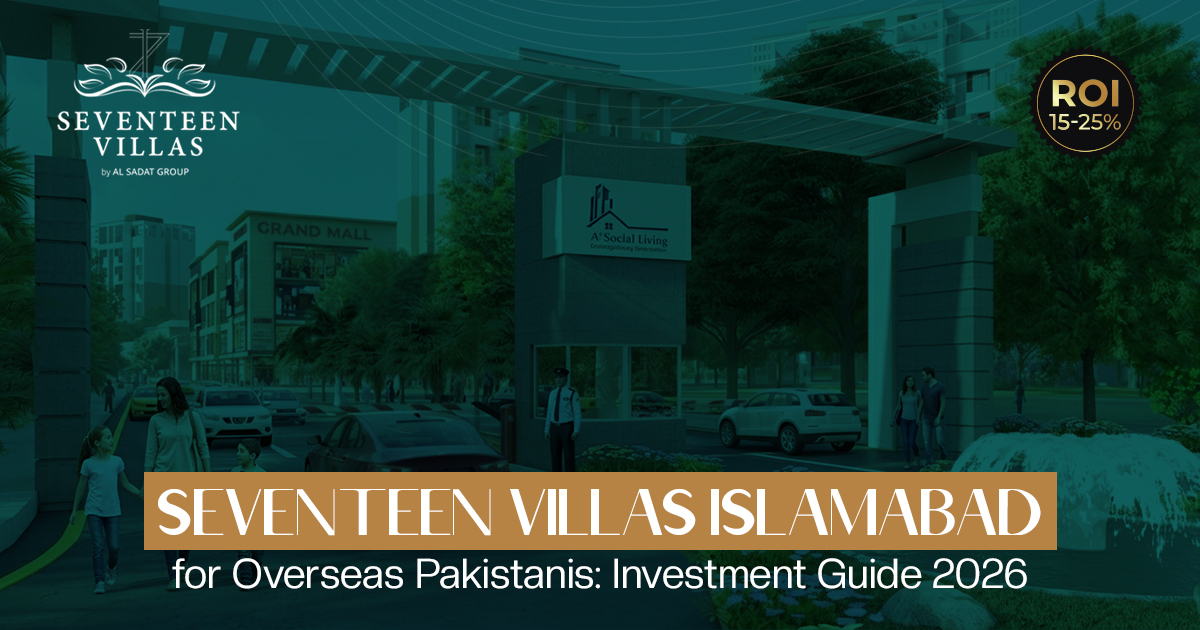
Every few years, a location shift in the Islamabad real estate market creates a window that experienced investors recognise before the wider market does. The completion of Islamabad International Airport was one such shift. It moved the city’s western frontier decisively — and the land corridor running from Thalian Interchange outward is still pricing in the early stages of what that move means.
Seventeen Villas Islamabad sits at the start of that corridor. This guide covers what the project actually offers, why the location has structural staying power, what overseas Pakistani buyers need to verify, and what realistic investment returns look like in 2026 — without the promotional gloss that usually surrounds new housing society marketing.
Location: Why Thalian Interchange Changes the Equation
Most real estate investment decisions come down to a single question: is this location going to matter more in five years than it does today? For Seventeen Villas, the answer is rooted in infrastructure that already exists — not plans that might be delivered.
The exact distances that matter
| Islamabad Ring Road | 1 minute |
| Girja Road | 1 minute |
| Islamabad International Airport | 4 minutes |
| Islamabad Toll Plaza → Thalian | 3 minutes |
| Daewoo Express Terminal, RWP | 5 minutes |
| Islamabad city centre | Approx. 25–30 minutes via Ring Road |
These are not marketing approximations. Seventeen Villas is the first residential project after Thalian Interchange — a position that cannot be duplicated by any future project in the same corridor. First-mover location advantage in housing society development is real and quantifiable: projects that anchor a new corridor consistently outperform those that follow.
The New Islamabad International Airport changed where Islamabad’s growth axis points. The old airport pulled development eastward along GT Road and into the older Rawalpindi belt. The new airport pulls it west — toward Thalian, toward CPEC-linked industrial zones, and toward the Ring Road network that connects everything. Seventeen Villas’ position is inside that pull, not outside it.
Why Overseas Pakistanis Are Looking at This Market in 2026
The overseas Pakistani property investment market has changed structurally over the last three years. Roshan Digital Account — introduced by the State Bank of Pakistan — removed the biggest friction point for diaspora buyers: the need to navigate informal banking channels to move money into Pakistan for property purchase. NICOP holders can now open an account, transfer funds, and complete transactions through a regulated banking pathway.
That change has brought a wave of buyers back into the formal market who previously either avoided it or used it informally. The cities they are looking at have not changed — Islamabad, Lahore, and Karachi remain the three primary targets. But within Islamabad, the areas attracting the most attention have shifted. DHA phases closer to the city are mostly mature, with entry prices that limit upside. The action is in the newer corridors — and Thalian is the newest serious corridor in the market.
What overseas buyers specifically value in Islamabad real estate
- Legal clarity — CDA, RDA, and PHATA approvals are verifiable and meaningful
- Gated security — properties that family members can use safely without the owner present
- Capital appreciation track record — Islamabad’s land market has consistently outperformed inflation over ten-year periods
- Rental income potential — for buyers who want the property working when they are not in Pakistan
Seventeen Villas addresses all five. All documents and maps are approved. The gated community model is built into the project design. The location provides both capital appreciation drivers and rental demand. And for the diaspora specifically, landing at Islamabad International Airport and being 4 minutes from your front gate is a material quality-of-life difference.
ROI Explained: What 15%–25% Annual Return Actually Means
Pakistan real estate ROI projections get misused frequently — either inflated to sell plots or dismissed entirely as unreliable. The 15%–25% annual range for Seventeen Villas is grounded in how comparable Islamabad-belt housing societies have performed during their development phases. Here is what that looks like in practice.
Capital appreciation — the primary return driver
When you buy in the development phase of a housing society, you pay pre-infrastructure pricing. As roads are laid, utilities are installed, amenities are built, and possession dates approach, the value of your plot adjusts upward to reflect what has been delivered.
Projects that followed a similar trajectory in the same Islamabad corridor include RUDN Enclave, OPF Housing Society, and Faisal Town Phase 2. Buyers who entered during the development phase and held through possession consistently achieved returns in the 15%–25% annual range. That history does not guarantee the same for Seventeen Villas, but it establishes the baseline expectation as realistic rather than promotional.
Rental income — the post-possession return layer
Once possession is handed over, the property can generate rental income. The airport corridor creates specific rental demand that most housing societies do not access: corporate accommodation, airline crew housing, and short-stay rentals for passengers with connecting flights or visa layovers. Gated villa-style properties near major international airports attract premium rental rates relative to their purchase cost.
A conservatively managed rental yield in this location, post-possession, could run at 4%–6% annually on the property’s appreciated value — adding a cash flow layer on top of the capital gain.
What Seventeen Villas Actually Delivers as a Development
Investment returns matter, but so does what you are buying. A plot in an incomplete, poorly managed society with weak development execution is a very different asset from a plot in a project that delivers what it promises on schedule.
Development specification
- Gated perimeter with controlled entry and security infrastructure
- Paved internal road network with underground utilities
- Residential plots in multiple sizes — 3.5 marla and 4 marla categories
- Parks, green spaces, and community areas built into the master plan
- Commercial zone within the society for daily-use retail
- Mosque and educational facility allocation in the master plan
The self-contained model matters particularly for overseas buyers whose families will use the property. When the nearest grocery, pharmacy, and mosque are within the society boundary, day-to-day living does not depend on the surrounding area’s development timeline — which, in a new corridor like Thalian, is still catching up.
Financing Options for Overseas Pakistani Buyers
PM Apna Ghar Scheme
For first-time buyers or those who want to reduce the upfront capital requirement, the PM Apna Ghar Scheme application guide outlines how eligible buyers — including overseas Pakistanis — can access government-subsidised financing. The scheme reduces the debt-to-income requirement and offers below-market loan-to-value ratios for qualifying properties and applicants. Eligibility criteria should be verified directly with the scheme administrators before applying, as programme terms are revised periodically.
Roshan Digital Account
Overseas Pakistanis with a Roshan Digital Account can remit funds directly for property purchase through a regulated banking channel. The account also offers Naya Pakistan Certificates as an alternative investment vehicle for those not yet ready to commit to direct property. For buyers who want to hold funds in Pakistan while completing due diligence, this is the correct pathway.
For a full breakdown of current plot prices, payment plan structures, and projected returns by plot category, the Seventeen Villas investment analysis provides the most current figures.
Long-Term Growth: Why the Thalian Corridor Has Structural Staying Power
Short-term price movements in Pakistani real estate respond to macroeconomic conditions — currency movements, inflation, interest rates, political cycles. Long-term value is determined by something more durable: whether the location is where growth is heading and whether the infrastructure to support that growth exists.
Both conditions are met at Thalian. The airport is built and operational. Ring Road is complete and carries significant daily traffic. The CPEC western alignment brings industrial and logistics development into the region surrounding the corridor. These are decade-scale investments by the state — they do not reverse with a change in government or a bad economic quarter.
The real estate development cycle in new infrastructure corridors follows a consistent pattern in Pakistan: first-mover projects establish price floors and attract early buyers; subsequent projects fill in the surrounding area; the corridor matures into a recognised address; prices stabilise at a significantly higher level than early-entry buyers paid. The Thalian corridor is in the early stages of that cycle. Seventeen Villas is positioned to capture the full appreciation arc rather than the mature end of it.
For overseas buyers with a five-to-ten-year horizon — which describes most diaspora investors planning for eventual return or intergenerational wealth transfer — that positioning is the core of the investment case.
Frequently Asked Questions
Q: Is Seventeen Villas a good investment for overseas Pakistanis?
A: Yes, for buyers who match the profile: All approvals are confirmed, the location has genuine infrastructure-backed growth drivers, and the entry price is still at the development-phase level. The 4-minute distance from Islamabad International Airport adds a rental demand layer that benefits overseas owners specifically.
Q: What is the expected ROI at Seventeen Villas in 2026?
A: Early-phase buyers are projecting 15%–25% annual capital appreciation based on comparable Islamabad corridor projects (RUDN Enclave, OPF Housing, Faisal Town Phase 2). Post-possession rental yield is estimated at 4%–6% annually on appreciated value. These are projections, not guarantees.
Q: Can overseas Pakistanis buy property at Seventeen Villas using NICOP?
A: Yes. NICOP holders are eligible to purchase property in Pakistan. Funds can be remitted through the Roshan Digital Account via a regulated banking channel, removing the need for informal transfer methods.
Q: Is real estate investment in Islamabad safe in 2026?
A: Islamabad’s property market is among the most regulated in Pakistan, with CDA, RDA, and PHATA providing verifiable approval frameworks. Buyers who verify NOC status independently, use regulated payment channels, and work with documented developers face significantly lower risk than those in informal or unapproved schemes.
Q: What is the minimum investment required at Seventeen Villas?
A: Plot categories start at 3.5 marla. Current pricing and instalment plan options are detailed in the investment analysis linked above. Instalment-based purchase allows staged capital commitment over the development period.