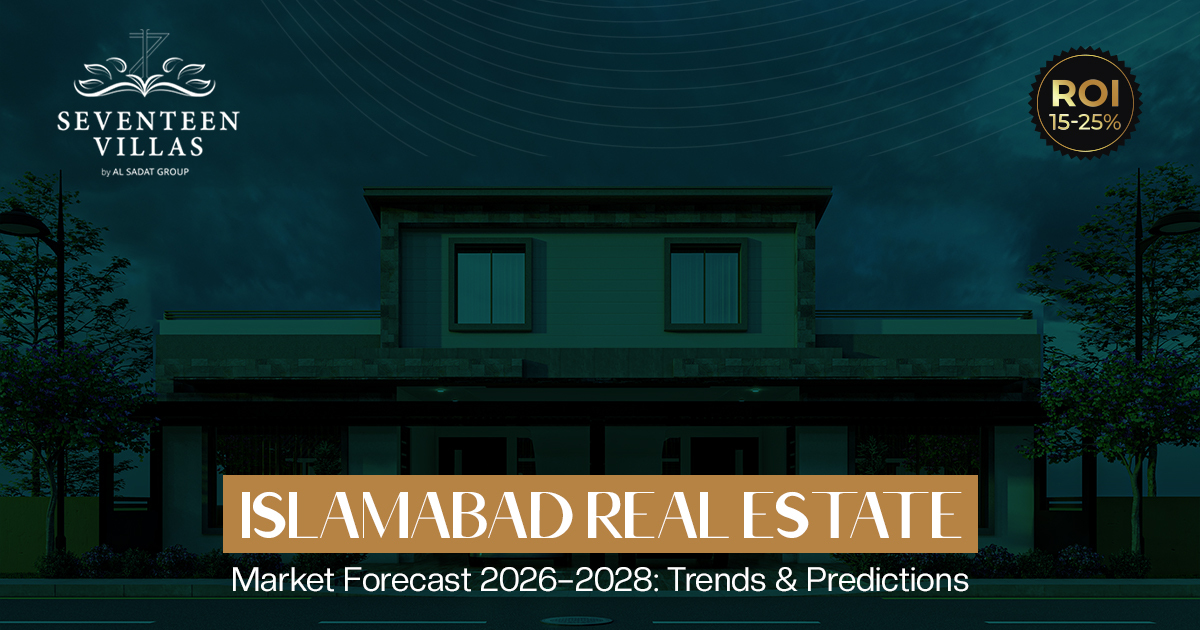
Islamabad has built a reputation as one of Pakistan’s most resilient property markets — a city where government presence, planned infrastructure, and consistent overseas demand have historically cushioned it against the volatility that affects more speculative markets. That reputation is being tested again as the city enters a new growth phase between 2026 and 2028.
Investors today are less willing to act on short-term sentiment alone. Rising financing costs in past cycles, regulatory shifts, and uneven plot-versus-construction returns have pushed buyers toward medium-term forecasting before committing capital. A three-year outlook, grounded in infrastructure timelines and demand fundamentals, has become a more reliable basis for decision-making than reacting to a single quarter’s headlines.
This forecast examines where Islamabad’s market stands today, the structural factors likely to shape pricing through 2028, and why premium villa communities such as Seventeen Villas are positioned to benefit from this cycle.
Islamabad Real Estate Market Overview
Islamabad’s property market has moved through a familiar cycle over the past several years: a sharp price run-up in 2022, a consolidation period through 2023–24, and what now appears to be an accumulation-to-growth transition heading into 2026. This is typically the phase in which informed investors position themselves, ahead of the broader market recognizing the shift.
- Market performance: Peripheral and peri-urban zones around Islamabad recorded meaningful price growth between 2023 and 2025, driven largely by infrastructure commitments rather than speculative buying.
- Demand trends: Demand has concentrated in well-located, infrastructure-adjacent housing schemes rather than spreading evenly across the city, reflecting more selective and informed buyer behavior.
- Buyer confidence: Easing financing conditions and continued overseas remittance inflows have supported buyer confidence even amid broader macroeconomic uncertainty.
- Premium housing growth: Demand for villas and larger-format homes has grown faster than demand for smaller plots, reflecting a shift toward lifestyle-driven, family-oriented purchasing.
Key Factors Driving Islamabad Property Growth in 2026–2028
Infrastructure expansion. Islamabad’s Ring Road project and related road network upgrades are reshaping accessibility across the city’s western and southern growth corridors. Properties located within accessible range of new interchanges have historically outperformed the broader market, and that pattern is expected to continue as remaining phases are completed through 2028.
Population growth and urban migration. Islamabad and Rawalpindi together form one of the fastest-growing urban clusters in the region. Sustained urban migration is pushing housing demand outward into peri-urban zones, supporting land values in areas that were considered peripheral just a few years ago.
Overseas Pakistani investment. Remittance-driven property investment has remained elevated, with overseas buyers increasingly favoring secure, well-documented projects with transparent payment structures over informal land deals. Luxury and villa-format housing has become a particular focus for this buyer segment, both for personal use and long-term capital preservation.
Limited premium inventory. Islamabad has a comparatively small supply of credible, professionally developed villa communities relative to demand. This scarcity tends to support faster price appreciation in the premium segment than in standard plot categories, where supply is more abundant.
| Is Islamabad real estate still a good investment?
Islamabad real estate remains an attractive medium-term investment for buyers prioritizing capital preservation and steady appreciation, particularly in infrastructure-adjacent and premium villa segments. As with any market, returns are not guaranteed and depend on project selection, location, and broader economic conditions. |
Property Price Predictions for Islamabad (2026–2028)
2026 Outlook: Market momentum is expected to build through 2026 as easing financing conditions and continued Ring Road progress draw renewed investor attention to peripheral zones. Price movement in this phase is likely to be gradual rather than sharp, consistent with an early-growth stage rather than a speculative spike.
2027 Outlook: As infrastructure projects move closer to completion and demand matures, price growth is expected to become more broad-based across well-located housing schemes. Villa and premium-format properties are likely to see comparatively stronger demand as buyer preferences continue shifting toward larger, lifestyle-oriented homes.
2028 Outlook: By 2028, areas that benefited from early infrastructure commitments are likely to show the clearest cumulative appreciation, assuming planned projects proceed on schedule. This longer-term view favors investors who entered during the 2026 accumulation phase rather than those who wait for visible price confirmation.
These projections are directional, not guaranteed. Actual price movement will depend on the pace of infrastructure delivery, macroeconomic conditions, interest rate policy, and broader political and regulatory developments. Investors should treat this forecast as a framework for decision-making rather than a fixed outcome.
Why Luxury Villas Are Expected to Outperform
- Lifestyle demand: Post-pandemic buyer preferences have shifted decisively toward larger living spaces, private outdoor areas, and family-oriented layouts rather than compact apartment-style units.
- Premium community structuring: Gated, professionally managed villa communities offer security, consistent infrastructure, and a more predictable living environment than informal housing developments.
- Capital preservation: Villas in well-located, professionally developed projects have historically held value more consistently through economic cycles than smaller, undifferentiated plots.
- Rental potential: Larger villa-format properties in established communities can command stronger rental rates from corporate tenants and families, supporting income potential alongside capital appreciation.
- High-end buyer demand: A growing base of high-net-worth individuals and returning overseas Pakistanis is specifically targeting villa-format housing over plots or apartments, narrowing supply in this segment relative to demand.
| Why are luxury villas becoming more attractive?
Luxury villas are becoming more attractive because they combine lifestyle demand, limited supply, and stronger capital preservation characteristics than standard plots or apartments. Buyer preferences have shifted toward larger, professionally managed communities that offer both comfort and long-term value retention. |
Why Seventeen Villas Is Well Positioned for Future Growth
Seventeen Villas is located on Girja Road near the Thalian Interchange, placing it directly within the Islamabad growth corridor most affected by Ring Road and CPEC-linked infrastructure development. The project sits roughly 1 minute from Ring Road and Girja Road access, around 4 minutes from Islamabad Airport, approximately 3 minutes from the M-2 motorway toll plaza at Thalian, and about 5 minutes from the Daewoo Terminal — a level of connectivity that is uncommon among villa communities at this price point.
- Prime Islamabad-adjacent location: Direct proximity to the Thalian Interchange and M-2 motorway gives residents and investors fast access to both Islamabad and Rawalpindi.
- Premium villa community: The project offers Executive Villas at 3.5 Marla and Prime Villas at 4 Marla, structured across 2, 3, and 4-bedroom configurations to suit a range of family sizes and budgets.
- Modern infrastructure: Gas and electricity approvals, a wide main boulevard, and gated-community security are positioned as standard rather than future promises.
- Quality development standards: Bank financing partnerships with leading institutions, offering up to 50% financing with flexible repayment tenures, reflect a level of institutional confidence not typical of early-stage informal developments.
- Family-oriented lifestyle: Villa layouts include private balconies, terraces, and covered parking, designed around the needs of growing families rather than investor-only plot speculation.
- Long-term value proposition: Positioned at the intersection of Ring Road and CPEC-linked growth corridors, the project is structurally aligned with the infrastructure catalysts expected to shape Islamabad’s market through 2028.
Current villa configurations, specifications, and floor plans are detailed on the Villas page. For a deeper look at current market timing and the broader case for entering Islamabad’s growth corridors now, see the Best Time to Buy Property in Islamabad 2026 Guide.
Expected ROI and Investment Potential
Capital appreciation in Islamabad’s premium villa segment is closely tied to the pace of infrastructure delivery, the rate of overseas investment inflows, and the persistent scarcity of credible villa-format inventory relative to demand.
Based on prevailing market trends, location advantages, premium inventory demand, and future development prospects, investors may potentially achieve returns ranging between 15% and 25% over the investment cycle. Actual returns depend on market conditions, timing, and overall economic factors.
| What ROI can investors potentially expect?
Based on prevailing market trends, location advantages, premium inventory demand, and future development prospects, investors may potentially achieve returns ranging between 15% and 25% over the investment cycle. Actual returns depend on market conditions, timing, and overall economic factors, and are not guaranteed. |
Detailed pricing across Executive and Prime Villa categories, along with current installment structures, is available on the Pricing page.
Who Should Consider Investing in Seventeen Villas?
- Overseas Pakistanis: Seeking a secure, documented investment in a high-growth corridor with structured payment plans suited to remote buyers.
- Luxury buyers: Looking for a professionally developed villa community with modern infrastructure and consistent build quality.
- Long-term investors: Building a position in an infrastructure-adjacent corridor ahead of the broader market recognizing its growth trajectory.
- Wealth preservation investors: Using premium real estate as a hedge against currency depreciation and inflation, consistent with traditional Pakistani investment behavior.
- Families upgrading lifestyle: Moving from apartments or smaller homes into villa-format living with private outdoor space and family-oriented community design.
Conclusion
Islamabad’s property market is entering a phase defined less by speculation and more by infrastructure delivery, demographic growth, and a measurable shift in buyer preference toward premium, family-oriented housing. The 2026–2028 window appears positioned to reward investors who act during the accumulation phase rather than after appreciation has already been priced in.
Within that broader picture, luxury villa communities anchored to major infrastructure corridors stand out as a comparatively well-supported segment. Seventeen Villas, positioned minutes from the Thalian Interchange and M-2 motorway, sits squarely within that opportunity.
As Ring Road and CPEC-linked development continue to mature through 2028, the entry pricing available today is unlikely to remain available indefinitely. Investors evaluating their position in Islamabad’s market have a narrowing window to secure that advantage.
Frequently Asked Questions
Is Islamabad property expected to increase in value?
Islamabad property values are expected to rise gradually through 2026–2028, driven primarily by Ring Road and CPEC-linked infrastructure completion, population growth, and continued overseas investment demand. The pace of appreciation will vary by location and project quality.
What are the best areas to invest in Islamabad?
Zones adjacent to the Islamabad Ring Road, the M-2 motorway corridor, and CPEC-linked growth areas are showing the strongest investment fundamentals, due to improving accessibility and concentrated infrastructure investment.
Are luxury villas a good investment?
Luxury villas in well-located, professionally developed communities have historically shown stronger capital preservation and appreciation potential than standard plots, supported by limited supply and a structural shift toward larger, lifestyle-oriented housing.
What ROI can investors expect in Islamabad?
Based on prevailing market trends, location advantages, and inventory demand, investors may potentially see returns in the range of 15% to 25% over the investment cycle. This is a market-level estimate, not a guarantee, and actual performance depends on broader economic conditions.
Why choose Seventeen Villas?
Seventeen Villas combines a location minutes from the Thalian Interchange and M-2 motorway with structured Executive and Prime Villa configurations, bank financing partnerships, and gated-community infrastructure, positioning it within one of Islamabad’s most active growth corridors.
Is 2026 a good time to buy property in Islamabad?
2026 is widely viewed by market analysts as a strategic entry point, given easing financing conditions, continued infrastructure delivery, and a market that has moved past its 2022 price correction into an accumulation-to-growth phase.
What factors influence property prices in Islamabad?
Property prices in Islamabad are primarily influenced by infrastructure development, population growth and urban migration, overseas remittance-driven investment, financing costs, and the relative scarcity of premium, professionally developed housing inventory.
How can overseas Pakistanis invest safely?
Overseas Pakistanis can invest more safely by selecting projects with transparent payment structures, documented legal status, and established bank financing partnerships, rather than informal land transactions without institutional oversight.