In 1994, Lahore’s Defence Housing Authority Phase 5 was considered far from the city. Most buyers wouldn’t touch it. Then the Lahore Ring Road was announced. Then built. Within four years, DHA Phase 5 went from a peripheral address to one of Lahore’s most coveted zip codes. Property values in the direct Ring Road corridor more than doubled within a decade.
This is not a coincidence. It is a pattern — one that repeats wherever large-scale road infrastructure connects previously inaccessible urban land to a city’s economic core.
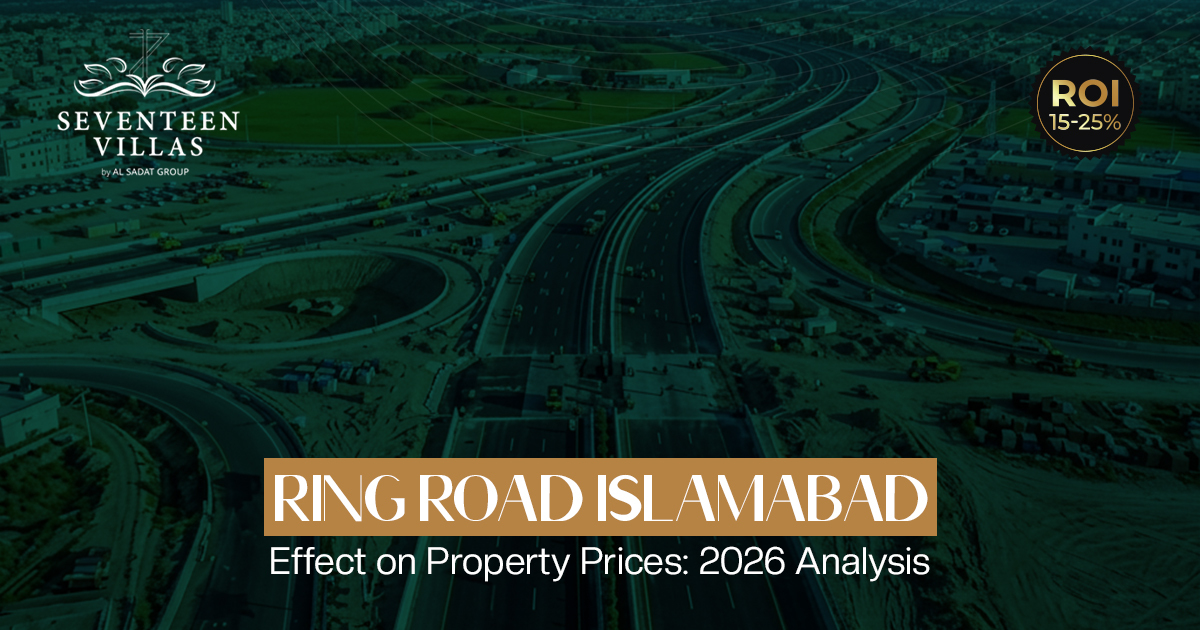
Islamabad is inside that same pattern right now. Ring Road Islamabad, one of the capital’s most significant infrastructure undertakings in recent memory, is doing for the southern and peripheral zones of the twin cities what the Lahore Ring Road did for DHA and Bahria in Punjab. It is collapsing distance, opening corridors, and pulling residential demand outward in a way that will permanently revalue land along its alignment.
Seventeen Villas — a structured residential villa project positioned within this corridor — is one of the projects sitting directly inside this demand shift. But before we examine its positioning, it is worth understanding the mechanics of what a ring road actually does to a real estate market, and why 2026 is a critical moment to pay attention.
Why Roads Rewrite Real Estate: The Infrastructure-Price Connection
Ask any serious property analyst what single external factor produces the most reliable long-term appreciation in residential real estate, and the answer is almost always the same: infrastructure connectivity.
The reason is not complicated. Property value is, at its core, a function of access. Access to jobs, to schools, to hospitals, to commercial centers — and the time cost of reaching them. When that time cost drops sharply because a new road opens, the perceived value of surrounding land increases without the land itself changing at all. The soil is identical. The plots are identical. Only the accessibility has changed. But accessibility is what buyers pay for.
Urban economists describe this as the “accessibility premium” — the price increment that buyers are willing to pay for reduced commute friction. Studies of the M-2 Lahore-Islamabad Motorway corridor showed property value increases of 60–80% in towns within a 10-kilometer band of interchange points within the first seven years after opening. The Karachi Northern Bypass produced similar outcomes, transforming Scheme 33 and surrounding areas from low-demand periphery into active investment corridors within five years of partial opening.
Pakistan’s real estate history is, in many ways, a history of infrastructure cycles. Each major road or motorway project has generated a predictable sequence: announcement → early investor entry → construction phase appreciation → completion → demand consolidation → sustained value plateau at a significantly higher base. The investors who understand and enter during the announcement-to-construction phase consistently outperform those who enter after the road is operational and the market has already repriced.
Ring Road Islamabad is in that construction-to-completion phase right now. That is the window.
Ring Road Islamabad: What the Project Actually Does
To understand the investment case, you need to understand the infrastructure itself — not in engineering terms, but in terms of what it changes for the average person living or working near it.
Islamabad was designed on a grid. The CDA master plan created a logical, sector-based city that worked well when the population was small and travel distances were short. As Rawalpindi expanded, as satellite communities developed in Bahria Town, Park Road, and the Srinagar Highway corridor, and as the twin-city population crossed the five-million mark, that original grid became a bottleneck. Main arteries became congested. Cross-city travel during peak hours became a significant daily friction point.
Ring Road Islamabad is built to break that bottleneck. The road creates a bypass arc that connects northern and southern zones of the capital without requiring traffic to pass through the city’s congested core. It links key entry points — Rawat, Sangjani, the Srinagar Highway junction, and outer-city access routes — in a way that distributes traffic load across the network rather than funneling everything through G-9, G-10, and the Kashmir Highway.
The practical outcome for residents in Ring Road adjacent communities is measurable. Commute times from areas that currently sit 40–50 minutes from central Islamabad during peak hours are projected to drop to 15–20 minutes once the bypass is operational. That is not a marginal improvement. A 25–30 minute daily commute reduction is the kind of quality-of-life shift that changes where people are willing to live — and by extension, where they are willing to buy.
For the real estate market, the significance of Ring Road Islamabad extends beyond commute reduction. The road is defining the next expansion zone of the capital. Islamabad cannot grow inward — the core sectors are built out. It cannot grow northward without significant topographical challenges. The Ring Road corridor and its adjacent zones represent the clearest, infrastructure-supported direction of outward urban expansion the city has seen in years. Where infrastructure leads, residential development follows.
2026 Islamabad Property Market: What the Data Is Telling Investors
Pakistan’s real estate market has moved through a volatile cycle over the past three years. The amnesty-era buying surge of 2020–2021 was followed by market correction pressure in 2022–2023 as interest rates climbed and currency pressures mounted. By late 2024, serious investors who had been watching from the sidelines began re-entering the market — particularly in Islamabad, where documentation requirements and CDA oversight provide a level of regulatory clarity that some other markets lack.
By 2026, several conditions are converging in Islamabad’s property market that create a distinct investment environment.
Land availability in the central sectors — F, G, I, and E series — is structurally limited. There are almost no new residential plots available in central Islamabad at accessible price points. This pushes demand outward, toward planned communities and projects in the periphery that offer new supply. Ring Road connectivity makes that peripheral supply viable in a way it wasn’t three years ago.
Inflation has, paradoxically, strengthened the case for real estate investment. When currency depreciation erodes savings, hard assets — land, constructed property — become the preferred store of value for middle and upper-middle income Pakistani families. Real estate in Islamabad, backed by CDA registration systems and clear documentation norms, is seen as among the more secure hard assets available in this environment.
The overseas Pakistani investor base has also returned as a meaningful force in 2025–2026, attracted by currency arbitrage and the relative stability of documented Islamabad projects compared to unregulated development in other cities. This additional demand layer is absorbing inventory in well-located projects faster than comparable periods in previous cycles.
The directional conclusion from these conditions: documented, well-located residential projects in Ring Road adjacent zones are in a position to benefit from compressed supply, sustained demand, and infrastructure-driven appreciation simultaneously.
The Zones Ring Road Is Moving Most in 2026
Not every area within a broad radius of Ring Road Islamabad benefits equally. Understanding which zones are experiencing the most active demand shift helps investors evaluate where opportunity is concentrated.
The Direct Corridor. Areas physically adjacent to the Ring Road alignment itself — including zones near the Rawat interchange, the southern bypass arc, and the Srinagar Highway-Ring Road junction — are experiencing the sharpest demand increase. These locations see both the largest commute time reduction and the earliest commercial development interest. Property prices in direct corridor zones have already begun moving — estimates from market observers suggest 15–25% appreciation over the past 18 months in some direct-corridor locations.
The First-Ring Communities. Planned residential communities within 3–7 kilometers of major Ring Road interchanges make up what investors typically call the “first-ring” zone. These communities benefit from Ring Road connectivity without the commercial noise of the immediate corridor. They offer residential lifestyle quality combined with infrastructure access — the combination that end-users and rental investors both prize. First-ring zone properties tend to show the most sustained appreciation profile because they attract both buyers and renters.
The Feeding Routes. Secondary roads that connect to Ring Road access points are experiencing increased development interest as investors and developers identify future demand pathways. Land on well-maintained secondary routes leading to Ring Road interchanges is being repositioned in the market from speculative to development-grade, a transition that typically precedes a sharper pricing increase.
Emerging Commercial Nodes. Interchange-adjacent commercial plots and mixed-use development zones are being acquired by commercial developers who are positioning ahead of the residential density that Ring Road access will generate. This commercial interest signals institutional-level confidence in the Ring Road corridor’s long-term trajectory.
Where Seventeen Villas Sits in This Growth Cycle
Seventeen Villas occupies a position in the Ring Road ecosystem that combines the location advantage of the first-ring zone with the entry-price advantage of a project still in its development phase.
The project’s proximity to Ring Road corridors means residents benefit from the commute time reduction that the infrastructure delivers — access to Islamabad’s commercial and employment centers without the daily friction of navigating through congested core sectors. For families and professionals who want modern villa-format living without sacrificing connectivity, this combination is exactly what the 2026 Islamabad buyer profile is seeking.
From a pure investment standpoint, Seventeen Villas sits at the stage of the appreciation cycle where the infrastructure benefit is established — Ring Road is real, its corridor is defined, and its impact on surrounding areas is already visible in market activity — but the full pricing impact has not yet been absorbed. Projects in this position typically offer what analysts describe as “asymmetric upside” — the downside of entry-level pricing is limited because the infrastructure driver is confirmed, while the upside of continued appreciation as the road completes and demand consolidates remains meaningful.
The villa format itself matters for the 2026 investor. Islamabad’s villa segment has outperformed the apartment segment in capital appreciation terms over the past five years, driven by a preference shift among buyers toward gated, horizontal living with private outdoor space. Post-2020, that preference accelerated globally and Pakistan was no exception. Seventeen Villas delivers a product that aligns with where end-user demand is firmly pointed.
For investors focused on rental yield rather than capital gains alone, the Ring Road connectivity advantage makes Seventeen Villas villas viable for the professional expat and senior corporate employee rental market — a tenant category that pays premium rents and prioritizes commute access over unit size.
Interested investors can View Current Payment Plan Details to assess the current entry structure.
The Investment Timing Argument: Why Early Entry Captures the Cycle
Real estate markets are not efficient in the way that equity markets are. Information travels slowly. Revaluation happens in stages, not instantly. And the buyers who act on an investment thesis before it is obvious to the majority consistently capture more of the appreciation than those who wait for confirmation.
The Ring Road Islamabad investment thesis is not hidden. It is visible in CDA approvals, in development activity along the corridor, and in the pricing movement already occurring in direct-corridor zones. But it is also not yet fully priced into every project in the first-ring zone. That gap — between what the market knows and what it has already priced — is where the timing opportunity exists.
Here is how the appreciation cycle typically unfolds for Ring Road adjacent residential projects. In phase one — the construction period — prices are set by the developer and reflect development cost plus a margin. Buyers at this stage are accepting timeline risk in exchange for the lowest available price. In phase two — as the road nears completion and market awareness increases — buyer competition for available units increases and the developer adjusts pricing or the secondary market becomes active at a premium to original prices. In phase three — post-completion, when Ring Road is operational — the accessibility benefit is visible to every buyer, demand peaks, and prices reflect the full infrastructure premium. The project’s earliest investors are sitting on gains that late entrants are now paying.
What happens to investors who wait? They buy into a market that has already moved. The logic that says “I’ll wait until the road is done to see if it’s really beneficial” is the same logic that converts a potential 40% gain into a 10% gain — by paying for certainty that early investors were rewarded for accepting as risk.
Where are you in this cycle today, relative to Seventeen Villas? That is the question an investment-minded buyer should be asking before the pricing gap closes further.
Honest Risk Assessment: What Every Investor Must Weigh
Any real estate analysis that skips the risk section is selling something, not analyzing something. The Ring Road investment thesis is credible, but it is not risk-free, and investors deserve a clear-eyed view of where the risks sit.
Infrastructure timeline risk is the most relevant. Ring Road Islamabad, like most large government infrastructure projects in Pakistan, has experienced phased progress and timeline adjustments. The full connectivity benefit may not arrive on the schedule that some developers’ marketing materials imply. Investors should build their return expectations around a medium-term horizon — three to seven years — rather than banking on a 12-month infrastructure trigger event.
Market liquidity risk is real in any Pakistani real estate cycle. The secondary market for villas in newer communities can be thinner than the market for central-city property, particularly during macroeconomic stress periods. Investors who may need to exit within one to two years face more uncertainty than those with a five-year-plus holding capacity.
Documentation and regulatory risk must be verified before any capital commitment. NOC status, CDA or RDA approval, developer registration, and project approval letters are non-negotiable checkpoints. No location advantage, infrastructure tailwind, or pricing opportunity replaces clear title and verified approvals. Ask for documentation before signing anything.
Currency and macroeconomic risk continues to affect Pakistan’s investment environment. Real estate offers partial protection against rupee depreciation — assets hold value better than cash — but is not immune to broad economic shocks that reduce buyer purchasing power and market activity.
The balanced assessment: the Ring Road infrastructure tailwind is real and documented in comparable market cycles. Seventeen Villas’ positioning within the growth corridor is a genuine location advantage. But real estate investment in Pakistan requires patient capital, verified documentation, and expectations calibrated to a medium-term horizon. Those conditions met, the risk-adjusted case for entry at current pricing is substantially more favorable than it will be post-completion.
Why Seventeen Villas at This Moment Is a Positioning Decision, Not Just a Purchase
There is a difference between buying property and positioning capital. A purchase is transactional. Positioning is strategic — it is the deliberate decision to place capital at an inflection point in a market cycle before the majority of participants recognize it.
Seventeen Villas in 2026 is a positioning decision. The Ring Road corridor is in its highest-leverage window: infrastructure is confirmed, development is visible, but pricing has not yet absorbed the full market impact of connectivity improvement that is coming. The villas are available at a price structure that will not survive another 18 months of Ring Road progress.
This does not mean panic-buying or ignoring due diligence. It means understanding that real estate cycles have windows, that windows close, and that the investors in Lahore who bought near the Ring Road in 2005 rather than 2010 are the ones writing the success stories. The story of Ring Road Islamabad is being written right now. Its most compelling chapters — for investors — are the ones happening in 2026, not in 2028 when the road is complete, the marketing has caught up, and the pricing reflects everything the market has learned.
Frequently Asked Questions
Q1: How much will Ring Road Islamabad increase property prices in surrounding areas?
Based on comparable infrastructure cycles in Pakistan — Lahore Ring Road, M-2 motorway corridor, Karachi Northern Bypass — property values in direct-corridor and first-ring zones have historically appreciated between 40% and 120% over five-year post-completion periods. Ring Road Islamabad is a comparable project in scale and connectivity impact. While specific appreciation percentages cannot be guaranteed and are subject to market conditions, the directional effect of major ring road infrastructure on adjacent residential property is well-supported by Pakistan’s own market history.
Q2: Which areas near Ring Road Islamabad are best for property investment in 2026?
The highest-impact zones are those in the direct Ring Road corridor (nearest interchange points), followed by planned residential communities in the first-ring zone — typically 3–7 kilometers from major access points. These first-ring communities combine Ring Road accessibility benefits with residential lifestyle quality and structured development timelines. They attract both end-users and rental investors, which supports sustained demand and more stable appreciation than purely speculative corridor land.
Q3: Is Seventeen Villas an approved and legally documented project?
Prospective investors should request and review the project’s NOC, CDA or RDA approval documentation, and developer registration before committing any capital. This is standard due diligence for any Pakistani real estate investment. Contact the Seventeen Villas investment team directly to obtain current approval documentation and project legal status.
Q4: What is the realistic investment timeline for Ring Road adjacent property in Islamabad?
Three to seven years is the appropriate horizon for infrastructure-driven real estate investment in Pakistan. The full accessibility premium of Ring Road Islamabad will be absorbed over multiple years following completion — not immediately. Investors entering at the current stage should plan for a medium-term hold to capture the full appreciation cycle. Short-term flipping strategies carry significantly higher risk in this market and timeline context.