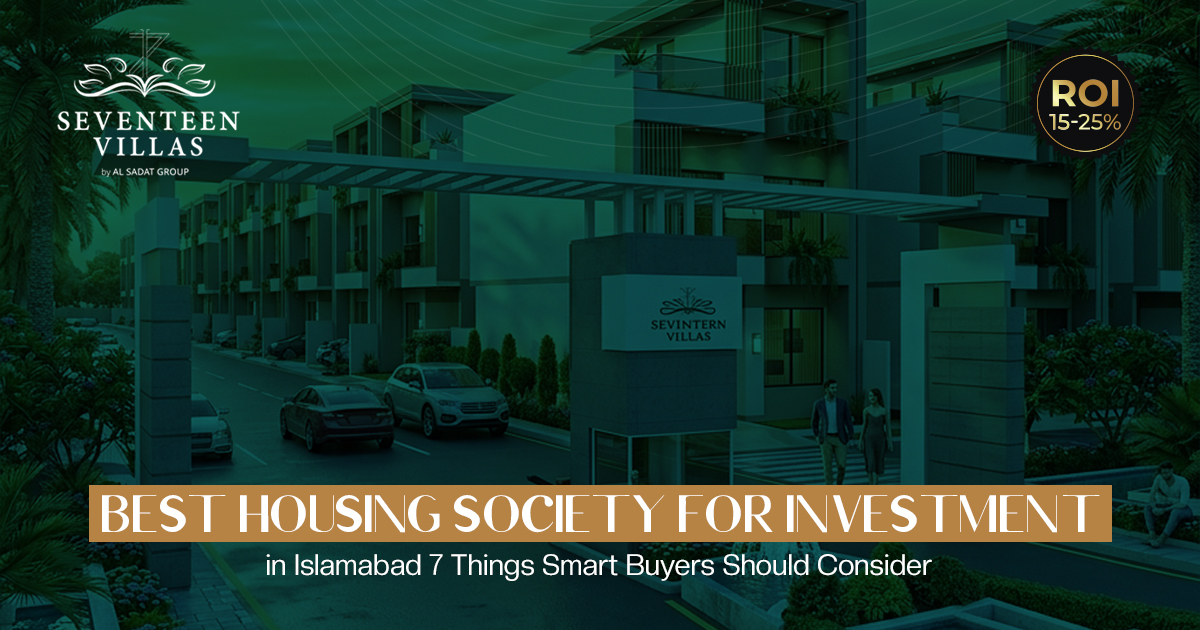
The best housing society in Islamabad isn’t the one with the most impressive entrance, the lowest advertised price, or the loudest marketing campaign. Smart buyers know that those three things say almost nothing about whether a project will actually hold and grow value. What matters is a set of fundamentals that don’t always make it into the brochure: location, legal status, development progress, developer credibility, pricing structure, genuine demand, and payment risk.
This guide breaks down the seven factors worth checking before investing in any housing society in Islamabad, and shows how a real project — Seventeen Villas near Thalian Interchange — fits into that evaluation.
1. Location and Connectivity
Location shapes almost everything else about a property’s long-term performance — commute time, accessibility, and how easily the area draws future residents and businesses. A housing society close to a major interchange or motorway generally offers more consistent demand than one requiring a long, unpaved approach road.
What to verify: actual drive time to the nearest highway or interchange, not the distance quoted in marketing material, and whether that access road is currently functional rather than planned.
2. Legal Status, Approvals, and Documentation
A housing society’s legal standing determines whether plots or units can actually be transferred and registered. In Islamabad, this typically involves confirming a scheme’s layout plan approval and NOC status with the Capital Development Authority (CDA); in the Rawalpindi corridor, the equivalent check runs through the Rawalpindi Development Authority (RDA).
What to verify: the scheme’s approval status directly with the relevant authority, since layout approval alone is not the same as a full NOC authorizing sale.
3. Infrastructure and Actual Development Progress
Marketing renders and site plans don’t confirm that a project physically exists. Roads, utilities, and boundary walls on the ground are a far more reliable signal of where a scheme actually stands.
What to verify: a site visit to see the current construction stage, utility connections, and whether the pace of visible work matches what’s being promised.
4. Developer Credibility and Delivery Record
A developer’s history — how long they’ve operated, how many projects they’ve delivered, and whether previous buyers received what was promised — is one of the strongest predictors of how a current project will play out.
What to verify: the developer’s completed project history, years in the market, and, where possible, direct feedback from existing buyers or residents.
5. Property Type, Pricing, and Affordability
Whether a plot, villa, or apartment fits a buyer’s goals depends on intended use as much as budget. Are villas better than plots for investment? Neither is universally better: a villa offers a ready-to-live home with no construction timeline or cost overrun risk, while a plot offers land-only flexibility and a broader resale pool. The right fit depends on whether the buyer wants immediate use, rental income, or a longer land holding.
What to verify: the full total cost including all charges, not just the advertised starting price.
6. Rental Demand, Resale Potential, and End-User Demand
A scheme surrounded by genuine residents, active rentals, and real day-to-day activity behaves differently from one that exists mostly as investor files changing hands. End-user demand is usually the more durable driver of long-term value.
What to verify: current rental rates and resale activity for comparable units in the same area, rather than projected figures from a sales pitch.
7. Payment Plan, Total Cost, and Investment Risk
The structure of a payment plan — down payment size, installment frequency, and possession terms — determines how much cash flow exposure a buyer carries over the holding period. A plan that fits comfortably within a buyer’s income reduces the risk of missed payments and forced resale.
What to verify: the complete schedule of payments, not just the headline booking percentage, and what happens if a payment is missed or delayed.
| Factor | Why It Matters | What to Verify |
|---|---|---|
| Location & connectivity | Determines commute, accessibility, and long-term demand | Actual drive time to highways, airport, city centers |
| Legal status & approvals | Confirms the plots or units can be legally sold and transferred | NOC and layout plan status with the relevant development authority |
| Infrastructure & progress | Shows whether the scheme exists beyond a brochure | Site visit, current construction stage, utility connections |
| Developer track record | Predicts likelihood of on-time, as-promised delivery | Past projects, delivery history, years in operation |
| Pricing & affordability | Affects both entry cost and realistic ownership plan | Total cost, installment structure, hidden charges |
| Rental & resale demand | Reflects genuine end-user interest, not just investor hype | Local rental rates, resale activity for similar units nearby |
| Payment plan & risk | Shapes cash flow exposure over the holding period | Down payment, installment schedule, possession terms |
Applying the Framework: Where Seventeen Villas Fits
Seventeen Villas, a residential project by Al Sadat Group, offers a useful example of how this seven-point framework applies in practice. The project sits near Thalian Interchange, positioned 1 minute from Ring Road/Girja Road, 4 minutes from the airport, 3 minutes from the toll plaza, and 5 minutes from Daewoo Terminal — giving it direct practical access to the wider Islamabad–Rawalpindi road network rather than relying on a single access point.
On the villa side, the project offers ready-to-move, double-story homes across Executive (3.5 Marla), Prime (4 Marla), and Royal (5.5 Marla) configurations, each with 2, 3, and 4-bedroom layouts — a structure that lets buyers choose based on family size and budget rather than a one-size option. It operates as a gated community with security features built into the layout.
On financing, the Seventeen Villas payment plan outlines a 5% booking amount, with the balance spread across quarterly or bi-annual installments and possession tied to a defined payment milestone, alongside bank financing options for eligible salaried buyers. As with any project, current pricing and terms should be confirmed directly before making a decision, since payment structures and availability can change.
None of this amounts to a guarantee of appreciation, rental income, or resale profit — no housing society in Islamabad can honestly offer that. What a location like this does is check several of the seven boxes: verifiable connectivity, visible ready-to-move inventory, and a structured, transparent payment plan that a buyer can evaluate on its own terms.
Making a More Informed Decision
Comparing housing societies in Islamabad is easier when it’s based on the same seven checks every time, rather than which project has the most persuasive sales pitch that week. Location, legal status, development progress, developer track record, pricing, genuine demand, and payment terms together give a far more reliable picture than any single factor on its own.
Buyers researching Seventeen Villas specifically, or comparing it against other options in the same corridor, can review the current payment structure or contact the Seventeen Villas team directly for up-to-date availability, pricing, and site visit scheduling.
Frequently Asked Questions
Which housing society is best for investment in Islamabad?
There’s no single universal answer. The best choice depends on an individual buyer’s budget, risk tolerance, and goals — the seven factors in this guide give a consistent way to compare any society, rather than relying on which one has the biggest marketing push.
What should I check before investing in a housing society?
At minimum, verify legal approvals with the relevant authority, confirm actual development progress with a site visit, review the full payment plan and total cost, and research genuine rental or resale demand nearby — not just projected figures.
Is location more important than price?
Location tends to have a longer-lasting effect on demand and livability, but price still has to fit a buyer’s budget and payment capacity. The strongest choice usually balances both rather than optimizing for one alone.
Are villas better than plots for investment?
Neither is universally better. A villa offers a ready-to-live home with no construction risk or timeline, while a plot offers land-only flexibility. The right choice depends on whether a buyer wants immediate use, rental potential, or a longer-term land holding.
What makes a property investment low-risk?
No property investment is risk-free, but risk is reduced by verified legal status, visible development progress, a manageable payment plan, and realistic demand — checked directly rather than assumed from marketing material.