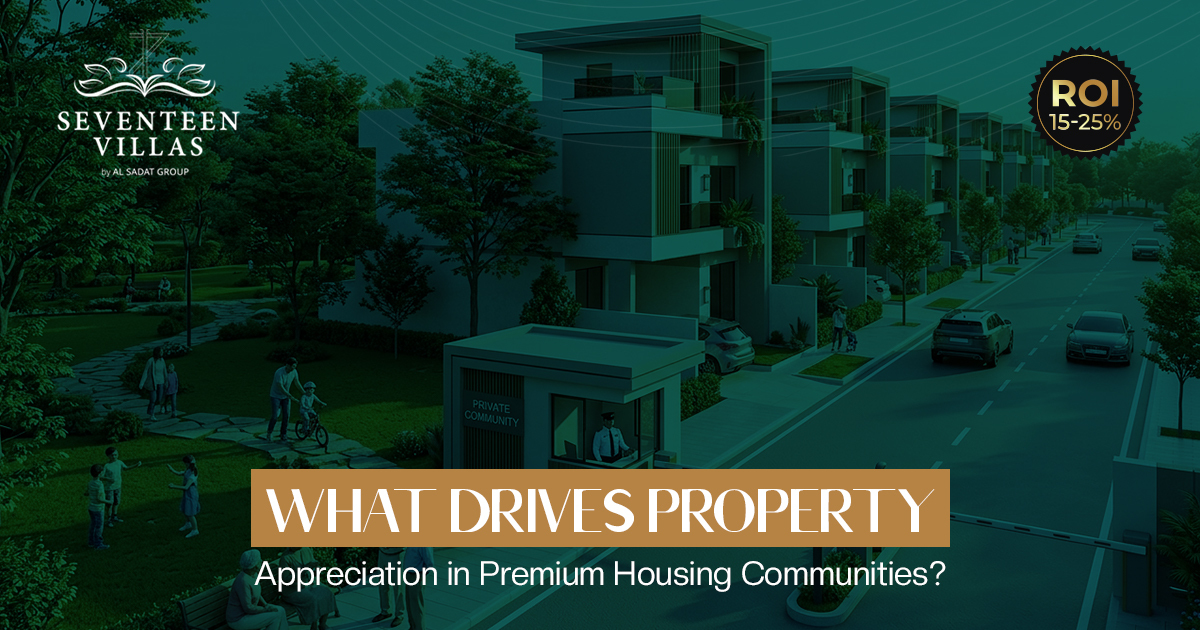
Property appreciation in premium housing communities is driven by strong master planning, reliable infrastructure, construction quality, developer credibility, security, and sustained demand. No single factor guarantees appreciation; value tends to build where these elements are consistently well executed together over time.
Two homes can look nearly identical today: similar size, similar finishes, similar asking price. Ten years later, one may be worth significantly more than the other, while its twin has barely kept pace with inflation. The difference rarely comes down to luck.
Property appreciation is shaped by a web of interconnected factors: planning quality, infrastructure, construction standards, demand dynamics, governance, and the less tangible pull of lifestyle and trust. Understanding how these factors interact is what separates informed property decisions from speculative ones.
This article breaks down exactly what separates communities that consistently build value from developments that simply exist.
Understanding Property Appreciation
Appreciation, in simple terms, is the increase in a property’s value over time. But not all appreciation is equal. Market growth reflects a rising tide across an entire region or city, often driven by inflation, urbanization, or broad economic expansion. Value creation, by contrast, happens at the community level, where specific decisions about planning, quality, and governance cause one development to outperform comparable properties nearby.
Short-term price movements can be driven by sentiment, speculation, or temporary demand spikes. Long-term appreciation is a different phenomenon entirely. It reflects whether a community continues to function well, attract residents, and retain its appeal a decade or two after launch, long after the initial marketing has faded.
Location Still Matters—But It’s No Longer Enough
Accessibility remains a foundational consideration. Proximity to employment hubs, transportation corridors, and essential services affects daily convenience, which in turn affects long-term desirability.
But location alone no longer explains why one community outperforms another nearby. Two developments on the same road can diverge sharply in value if one benefits from planned regional infrastructure, such as improved transportation links or urban expansion, while the other does not. Buyers increasingly evaluate not just where a property sits today, but how the surrounding area is expected to evolve.
Master Planning Creates Long-Term Value
A master plan is the blueprint that governs how a community will function for decades, not just how it looks on launch day. Road hierarchy, the separation of primary and secondary traffic flow, prevents congestion as a community matures. Green spaces and walkability are not cosmetic additions. They shape how residents actually experience daily life.
Thoughtful land allocation, balancing residential, commercial, and recreational space, also determines whether a community can accommodate future expansion without undermining what made it attractive in the first place. Developments that skip this planning stage often show their limitations only after residents have already moved in.
Construction Quality Protects Investment
Engineering and architectural standards affect far more than aesthetics. Structural quality determines how a property withstands time, weather, and use, while premium materials tend to reduce long-term maintenance costs for owners.
Buyers evaluating construction quality should look past surface finishes toward the underlying standards: foundation work, structural engineering, and the durability of core building systems. These elements are harder to inspect but matter far more to long-term ownership costs than a well-styled show unit.
Lifestyle Amenities Increase Demand
Shared amenities, clubhouses, fitness facilities, parks, walking trails, and dedicated children’s spaces, extend a property’s appeal beyond the four walls of an individual home. They shape how a community feels to live in day to day, which directly affects demand from future buyers.
Recreation and outdoor living spaces matter particularly to families, who often weigh quality of life as heavily as square footage when choosing where to invest long-term.
Security Builds Buyer Confidence
Secure communities tend to maintain stronger, steadier demand. Controlled access and consistent surveillance reduce a source of everyday anxiety for residents, particularly families with children or frequent travelers.
Professional community management, rather than security left to individual households, signals that a development takes long-term resident confidence seriously. This kind of structured security is increasingly a baseline expectation among buyers considering premium communities, not a luxury add-on.
Infrastructure Determines Future Appreciation
Reliable utilities, well-planned drainage, dependable power, and strong internet connectivity are easy to overlook when a community is new, but they become decisive over time. Poor drainage planning, for example, can cause recurring problems that damage a community’s reputation years after launch.
Sustainability and future readiness, including how well infrastructure can scale as a community grows, increasingly factor into how sophisticated buyers evaluate long-term investment potential.
Developer Reputation Matters
A developer’s track record is one of the clearest signals available to buyers before a community is fully built out. Consistent, on-time project delivery suggests operational discipline. Transparency in communication and documentation suggests a developer willing to be held accountable.
Governance structures, how disputes are handled, how maintenance is funded, how community rules are enforced, often matter more to long-term satisfaction than any individual amenity. Buyers who research a developer’s history across multiple projects, not just marketing materials for the current one, make better-informed decisions.
Supply and Demand in Premium Communities
Limited inventory tends to support demand, particularly in communities with strong planning and reputation. Exclusivity is not simply a marketing term. It reflects genuine scarcity when a development caps the number of units or plots available.
This dynamic contributes to market resilience. Communities with genuine scarcity and sustained buyer interest tend to weather broader market softness more steadily than developments with unlimited or poorly controlled supply.
The Psychology of Premium Living
Property decisions are rarely purely financial. Status, sense of community, and pride of ownership all factor into why buyers choose one premium development over another with similar specifications.
Well-being and quality of life, having space to walk, safe areas for children to play, a genuine sense of neighborhood, carry real weight in buyer decision-making. This emotional value is harder to quantify than square footage, but it consistently shows up in what buyers describe as their reason for choosing a particular community.
Economic Factors That Influence Appreciation
Broader economic conditions shape the environment in which any property investment sits. Inflation affects construction and replacement costs. Interest rates influence financing accessibility and buyer demand. Urbanization and population growth expand the pool of potential buyers in a given region over time.
Income growth within a target buyer segment also plays a role, as does the length of a particular housing cycle. These factors are general market influences rather than predictors specific to any one community, and past performance in any market should not be read as a guarantee of future results.
How Buyers Can Evaluate a Premium Community Before Investing
A structured evaluation process helps buyers separate genuine long-term value from persuasive marketing. Consider each of the following areas before committing to a purchase:
- Developer credibility: review delivery history across multiple completed projects.
- Location: assess both current accessibility and planned regional infrastructure.
- Infrastructure: confirm utilities, drainage, and road networks are properly planned.
- Community planning: examine the master plan for land use, green space, and traffic flow.
- Amenities: evaluate which shared facilities are built, funded, and actually maintained.
- Legal due diligence: verify land title, approvals, and documentation with proper legal support.
- Maintenance model: understand who manages upkeep and how it is funded long-term.
- Future development: consider how remaining phases may affect the completed community.
- Market demand: research resale activity and buyer interest in comparable communities.
- Long-term livability: weigh quality of life factors as seriously as financial projections.
No investment decision should rest on a single factor from this list. Appreciation potential, like the communities that generate it, comes from how well these elements work together, and no evaluation process can eliminate market risk entirely.
How Seventeen Villas Reflects the Principles of Premium Community Development
Seventeen Villas approaches community development with the same fundamentals discussed throughout this article: thoughtful master planning, attention to construction quality, and a design philosophy centered on how residents will actually live in the space, not just how it will photograph at launch.
The community’s connectivity reflects deliberate location planning: roughly one minute from Ring Road and Girja Road, around four minutes from the airport, close to three minutes from the toll plaza, and about five minutes from Daewoo Terminal. These are practical accessibility considerations, not incidental details.
Beyond location, the emphasis remains on long-term resident experience: planned green spaces, structured community management, and a lifestyle designed around everyday livability. As with any real estate investment, prospective buyers should evaluate whether this approach aligns with their own goals, and should treat any discussion of long-term value as general guidance rather than a guarantee of specific investment returns.
Conclusion
Property appreciation is rarely accidental. Communities that consistently retain and build value tend to share the same underlying fundamentals: disciplined planning, genuine construction quality, dependable infrastructure, credible governance, and demand that holds up over time, not just at launch.
Buyers who evaluate premium communities through this lens, rather than through short-term price movements or persuasive marketing, tend to make more informed, more durable investment decisions. As with any property investment, individual circumstances vary, and past appreciation trends do not guarantee future performance.
If these principles resonate with how you think about long-term property investment, exploring Seventeen Villas Islamabad in more depth may be a natural next step. You can reach the team at +92 312 5236793 or info@seventeenvillas.com to learn more about the community’s master plan and current availability.
Key Takeaways
|
Ordinary Development vs. Premium Planned Community
| Factor | Ordinary Housing Development | Premium Planned Community |
| Planning approach | Plots sold with minimal shared design | Master plan governs land use, roads, and green space from day one |
| Infrastructure | Utilities added incrementally, often reactively | Utilities, drainage, and roads planned ahead of demand |
| Security | Variable, often left to individual households | Centralized access control and community management |
| Amenities | Limited or absent shared facilities | Clubhouses, parks, and recreational spaces built into the plan |
| Maintenance model | Inconsistent, dependent on residents | Structured maintenance managed by the community or developer |
| Long-term value pattern | More exposed to market volatility | Tends to retain value more consistently over time |
Frequently Asked Questions
Does location alone determine property appreciation?
No. Location matters, but planning, infrastructure, construction quality, and developer reputation all influence whether a property’s value grows consistently over time.
How long does it typically take for a premium community to show meaningful appreciation?
Appreciation timelines vary by market and location. Long-term fundamentals such as infrastructure completion and community maturity generally matter more than short-term price movements.
What is the difference between market growth and value creation?
Market growth reflects broader price movements across a region, while value creation comes from a specific community’s planning, quality, and demand relative to comparable properties.
Why do gated communities often maintain stronger demand?
Centralized security, consistent maintenance, and controlled access give residents confidence, which tends to support steadier demand compared to areas without shared management.
Is buying in a newly launched community riskier than an established one?
Newer communities carry more uncertainty about how the plan will be executed. Reviewing developer track record and approved planning documents helps reduce that uncertainty.
How important is a developer’s track record?
Very important. A developer’s history of delivering projects on time and maintaining transparency is one of the clearest indicators of how a community will be managed long-term.
Do amenities really affect resale value?
Well-maintained shared amenities, such as parks, clubhouses, and security infrastructure, tend to make a community more attractive to future buyers, which can support resale demand.
What legal checks should buyers do before investing?
Buyers should verify land title, approved layout plans, and relevant regulatory approvals through proper legal due diligence before committing to a purchase.
How does infrastructure quality affect long-term value?
Reliable utilities, drainage, and road networks reduce future maintenance costs and disruption, both of which support a community’s ability to retain value over time.
Are premium communities a good investment during economic uncertainty?
Premium communities with strong fundamentals often show more resilience during uncertain periods, though no property investment is immune to broader economic conditions.
What role does exclusivity play in property value?
Limited inventory and controlled development density can support demand, since scarcity often increases desirability in well-planned, well-located communities.
Should buyers prioritize current amenities or future development plans?
Both matter. Current amenities affect immediate quality of life, while future development plans indicate how the community’s value proposition may evolve over time.
What is the biggest mistake buyers make when evaluating appreciation potential?
Focusing on short-term price trends rather than long-term fundamentals such as planning quality, infrastructure, and developer credibility is one of the most common mistakes.